Why spend a few days in Teruel? This small town in Aragon proves that the Muslim influence on art in the Iberian Peninsula endured after the Reconquista.
Here’s how I spent those few hours in Teruel, the starting and finishing point of my cycling trip along the Montañas Vacías route.
A cycle ride in Teruel
I arrive by bus late in the morning. After fitting the front wheel back onto my bike which had been split in two in the luggage compartment, I set off towards the town centre. The street climbs and, at the bend, joins a network of narrower streets. I have to step off my bike in the staircase leading downwards. They lead to a large square.
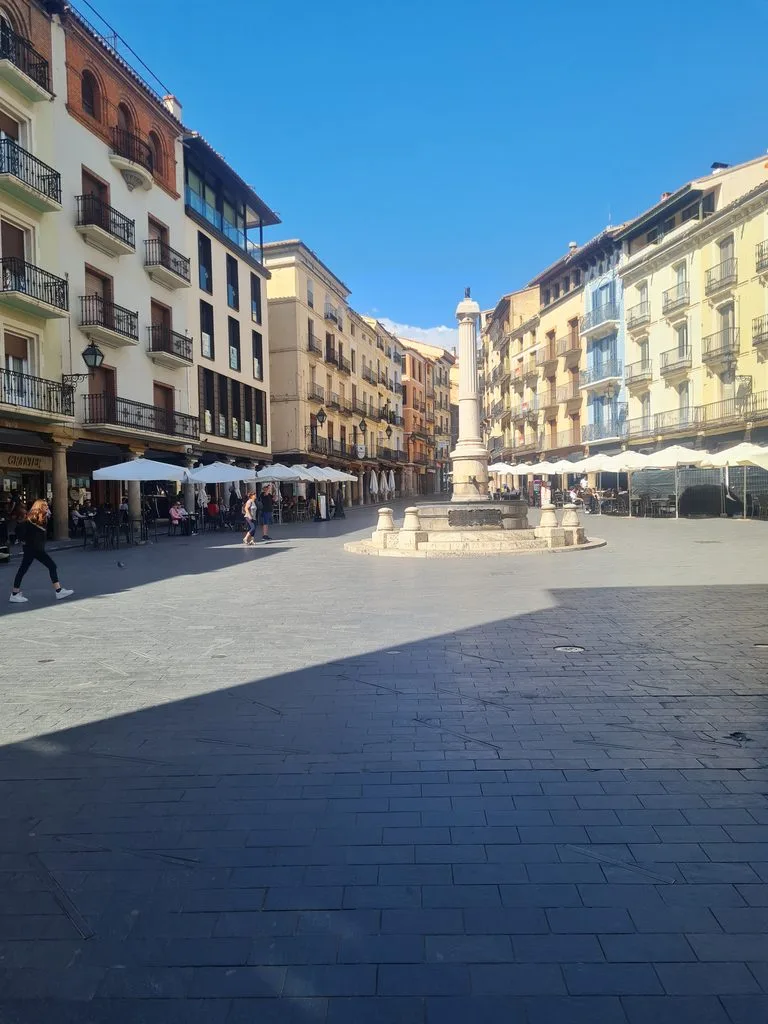
It’s home to numerous food shops. A fountain adorned with a column topped by a bull’s head comes into view. This is the Plaza del Torico. Tourists are taking photos of themselves in front of the salmon-coloured or pale yellow façades, which feature beautiful balconies. The appearance of these balconies confirms that I am indeed in Spain. One building stands out for its blue colour and modernist architecture. The inscription ‘1912’ is visible at the very top of the façade.
I carry on, pushing my bike along a street lined with colonnades housing bars and restaurants. After walking across the square several times in search of somewhere to have lunch, I settle on a large bar-restaurant whose blackboard displayed the words “Jamon de Teruel DOP”. Lorena, Pepe’s girlfriend – with whom I stayed in Valencia yesterday – told me that Teruel hams are renowned.
I’m a vegetarian but willing to make the odd exception to my diet to try local specialities. The ham’s Protected Designation of Origin is a good reason. I order three bocadillos. The waitress is cold, even unpleasant. She seems surprised by my order and asks me if any of the sandwiches are to take away.
I choose a bocadillo with Teruel DOP ham, one with ham and omelette, and one with sausage and peppers. When I see the three enormous half-baguettes arrive at my table, I realise why the waitress was surprised.
I relax. Seeing and eating this delicious, hearty food makes me happy. I tuck in. These calories will help me cover the more than 50 km that await me today. I force myself to wolf it all down.
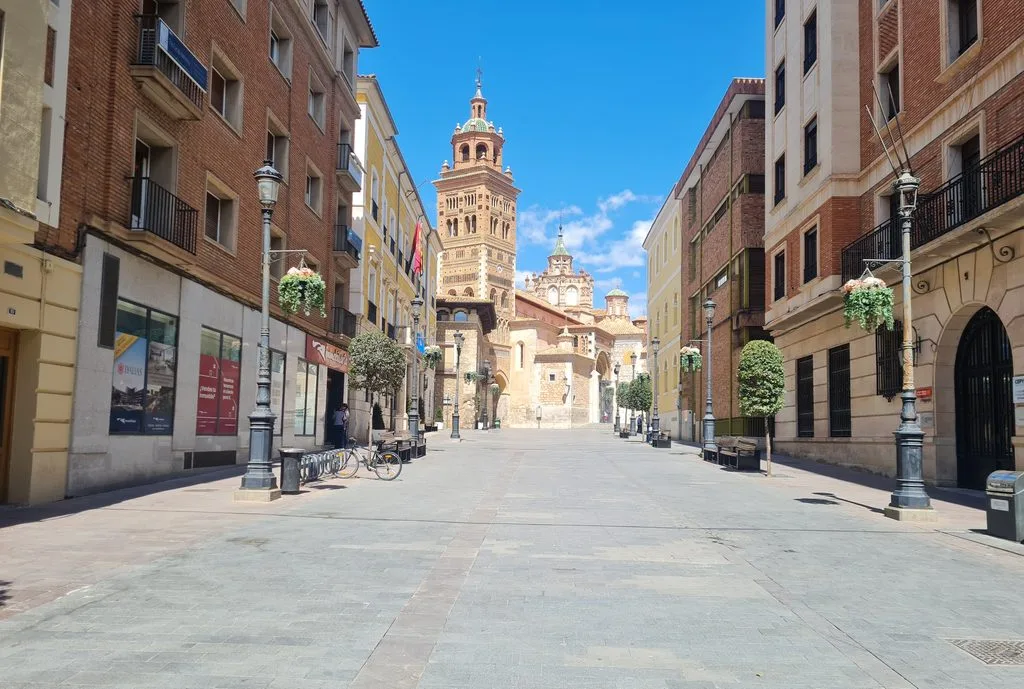
Let’s set off on a tour of Teruel. I get back on my bike and cycle aimlessly through the streets, keen to see what surprises I might find. The imposing cathedral comes into view. I don’t want to go inside it, or any other monument for that matter. Partly because I don’t have much time, and partly because admiring them from the outside is enough for me.
Azulejos featuring green, geometric patterns – such as circles and diamonds – adorn the cathedral. I also notice the windows, whose shapes resemble those of the Alhambra in Granada. I find them magnificent. A jewel of Arab-Andalusian architecture and the embodiment of human genius, this building of white and ochre stone is well preserved. Taken individually, the patterns seem rather ordinary to me, but when I look at the building as a whole, I find them fascinating.
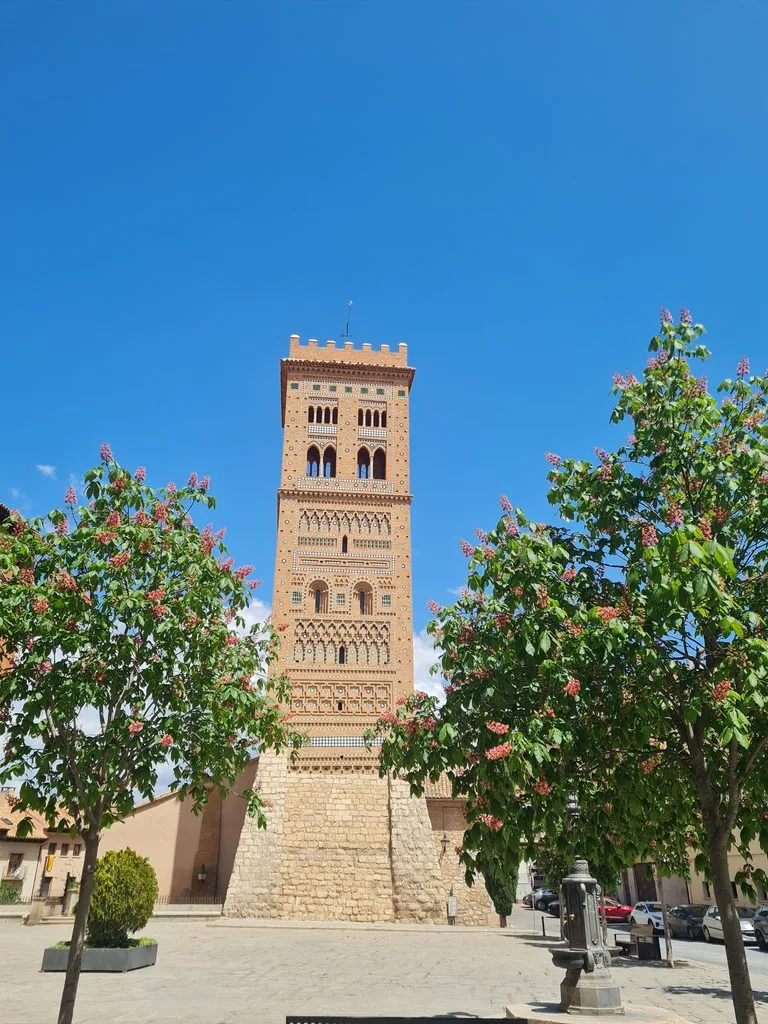
Next, I stop in front of the San Pedro Tower, then in front of the San Salvador Tower. These tall brick buildings also feature beautiful geometric patterns. The builders of that era had an eye for beauty and attention to detail.
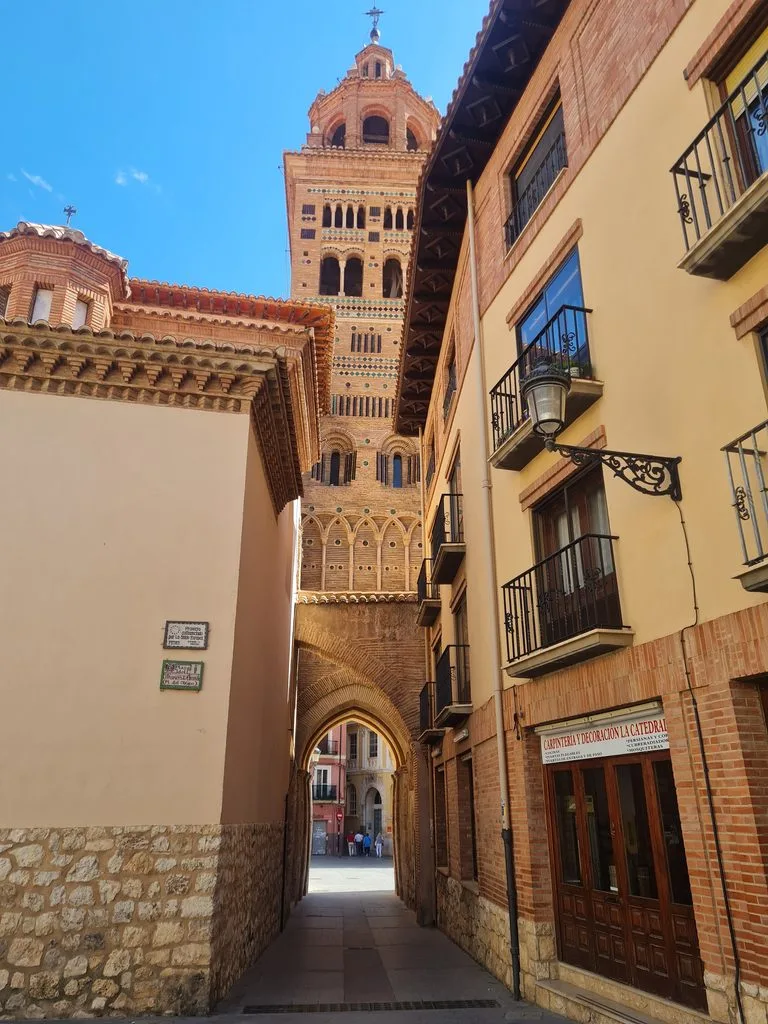
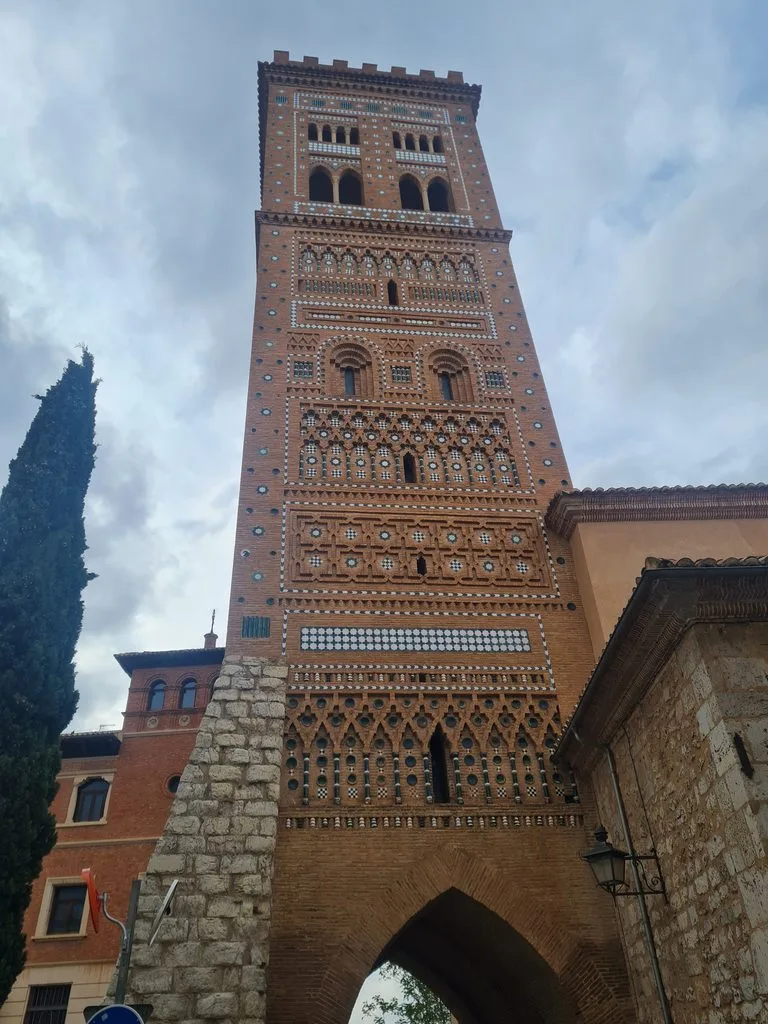
One style, three cultures
The Mudéjars were Muslims living in Christian territories following the Reconquista. The Kingdom of Aragon allowed them to remain on its lands from the 12th century onwards, but expelled them in the 17th century.
Mudéjar art, which flourished during this period, symbolises the peaceful coexistence of Christian, Muslim and Jewish cultures. Each influenced the buildings constructed in this style in its own way. These buildings often feature diamond-shaped mouldings, known as sebqa, as well as green ceramic stars and spires.
Ten monuments in the autonomous community are listed on UNESCO’s World Heritage List under the category of Mudéjar architecture. Four are located in Teruel: the towers of San Pedro, San Martín and San Salvador, as well as the cathedral.
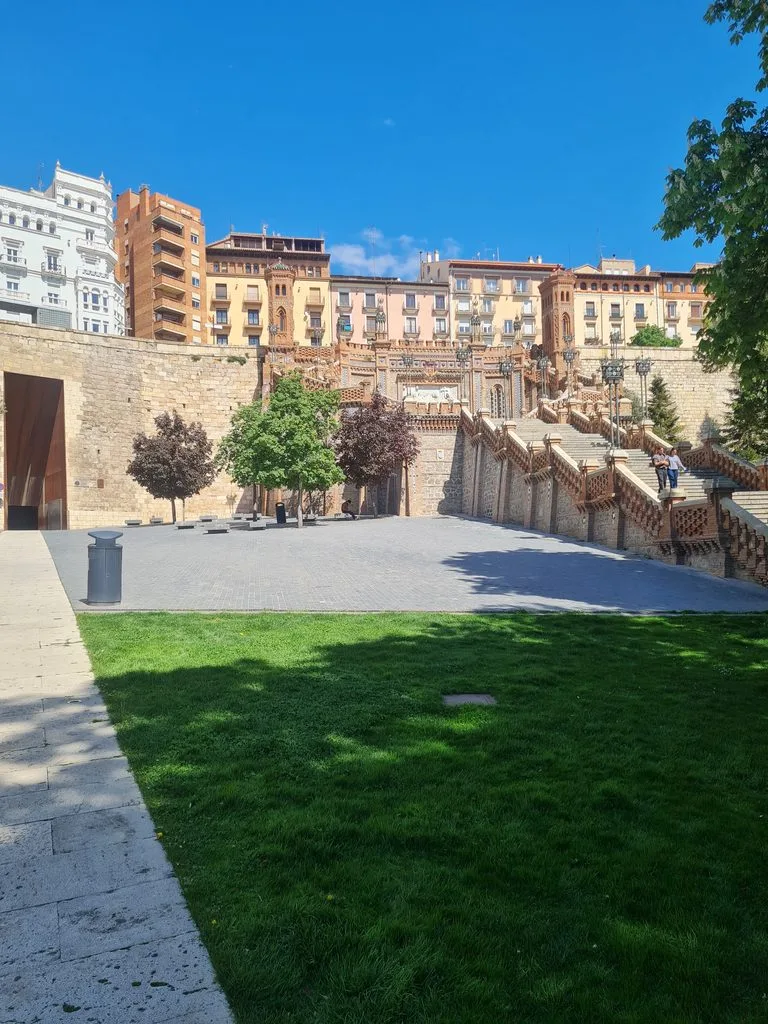
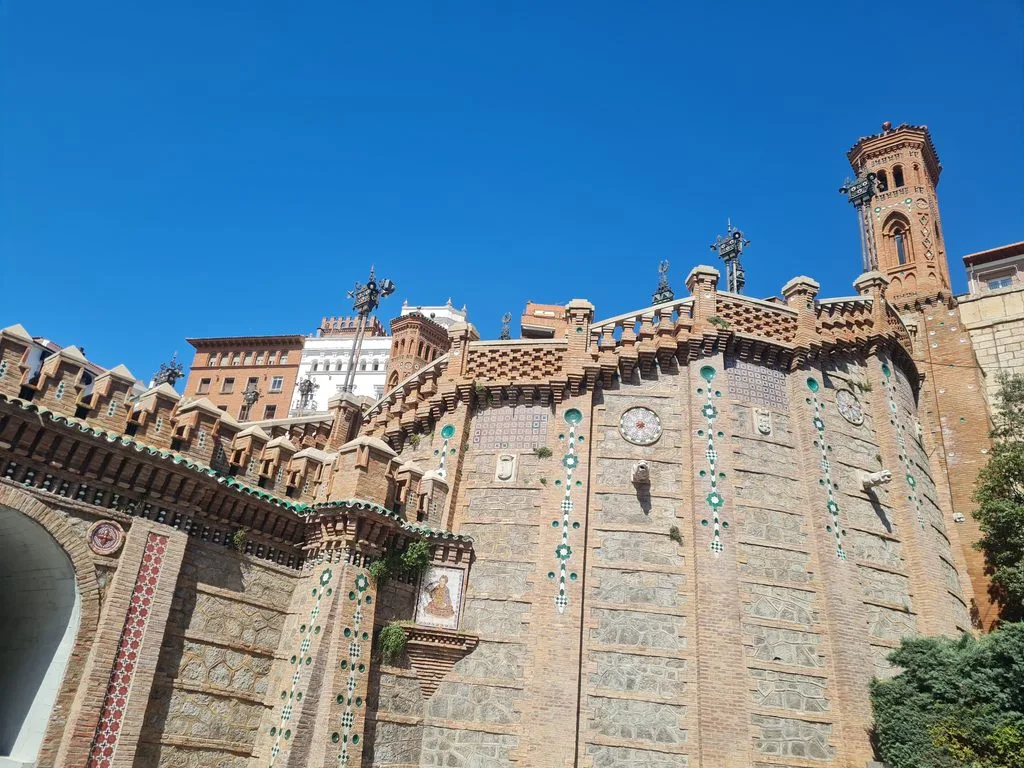
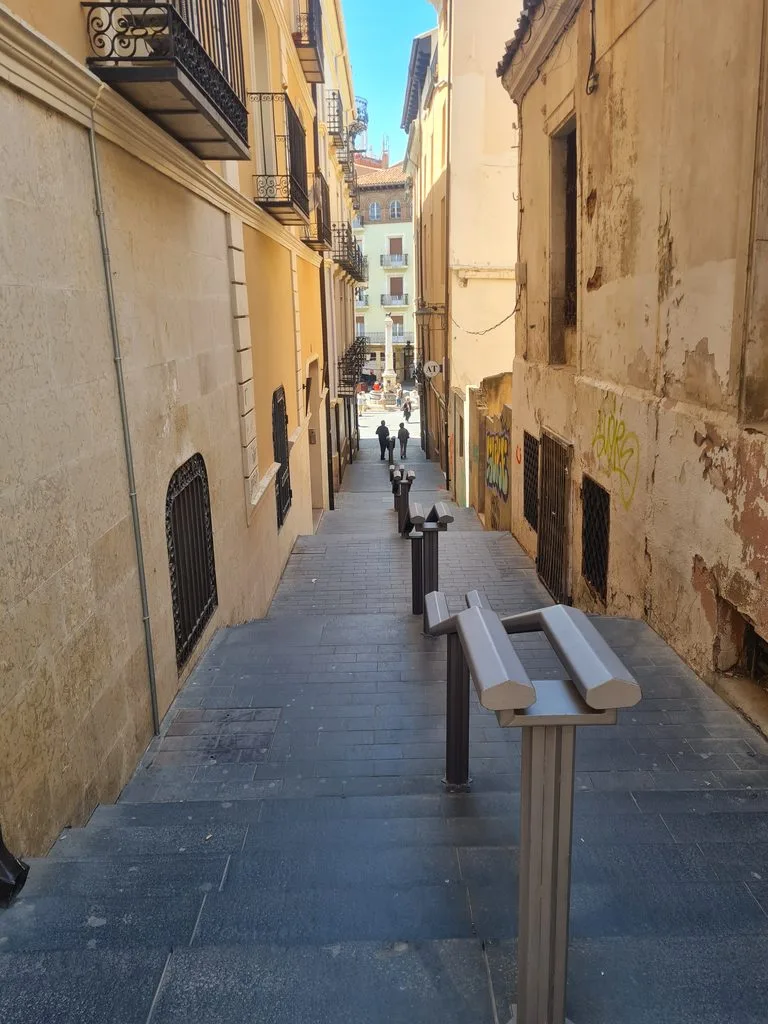
Since the 18th century, this artistic form has given rise to the Neo-Mudéjar style, an example of which is the staircase connecting the lower and upper parts of Teruel.
My Valencian hosts told me that the town was built on two levels and that one sometimes had to climb. Indeed, as I pass beneath the San Salvador Tower, I find myself facing a long road that winds its way down in a sweeping bend. I set off down it at full speed. A large aqueduct spans the road. I notice a pedestrian crossing this beautiful stone structure.
I stop near a small park where children are playing. From there, I admire the majestic staircase leading up to the upper part of the town. On the information board, I see a vintage black-and-white photograph dating from the early 20th century.
I want to head back up to the town centre before I set off. To do that, I’ll need to push my thighs as I climb the hill. In the middle of the afternoon, under the intense April sun, I have to take my time rounding the bend because my stomach is full.
The hours leading up to a long cycle ride are special. I want to set off straight away, yet at the same time, it would be a shame not to make the most of this town, which is more beautiful than I thought. Teruel has a relaxed atmosphere. I like its intimate scale.
One of the main attractions is the Mausoleum of the Lovers of Teruel, which Pepe and Lorena told me about. I’m not familiar with the story behind it and don’t feel like visiting it.
Back at the Plaza del Torico, I weave my way through the tourists and place my hand on one of the bull’s heads adorning the imposing fountain. This time, I set off. It’s 5 pm.
Deepdiving in the history of Mudéjar’s art
After seven days in the mountains, I’ve completed the 580-km loop. The medieval town is shrouded in clouds early this morning. The Plaza del Torico isn’t very busy, but the cafés are already open. I choose one that looks less crowded than the others. I’m delighted to have a rest.
I had a bad night’s sleep because the terrace of the little house didn’t shelter me from the cold. What’s more, the place smelled awful. I’m delighted to be warm and to be having a coffee with churros – a second breakfast after the one I ate as soon as I woke up, outside my tent.
The café’s customers look like locals from Teruel. Some are reading the newspaper. I spot one folded on a table and pick it up. It’s the Diario de Teruel. A photo on the front page shows a May Day demonstration that took place yesterday. I read the news in Spanish with interest.
I’m disorientateed by the large amount of people in the café, as I’ve seen very few people during my week-long cycle trip. Returning to the hustle and bustle of the city has to be a gradual process after the silence of the countryside. Once my mobile’s charged, I cycle through the streets, which are still fairly quiet. I have to dismount on the numerous flights of steps.
The Mausoleum of the Lovers in Teruel comes into view again. I still don’t feel like visiting the modern building that houses the lovers’ remains, as there’s probably not much to see. I find a spot on a quiet street, at the foot of the wall of a church. It’s the perfect place to rest. I lie down on the ground. However, I make sure I don’t fall asleep, so I can keep an eye on my bike and my panniers. I can’t wait for lunchtime to come round.
A restaurant spotted on Google Maps with a good rating attracts me: the Amor Amor bar. It’s not even half past twelve yet. They’ll be surprised to see me at this time of day. When I walk into this little restaurant in the town centre, I see only one other customer.
The owner gives me a warm welcome. He’s one of those people who radiate the joy of doing a job they love. His ‘gastro bar’, with its simple décor, serves very elaborate tapas. I choose some cod croquetas and pig’s ears in sauce.
I enjoy the food and the place is pleasant. However, I feel a bit queasy looking at the pig’s ears, realising that I’m eating part of the animal’s head.
Next, I head to the tourist information centre, located on the ground floor of the ‘Lovers’ Tower’ in Teruel. Two women are working at the reception desk.
– “I’d like to explore Mudéjar art. Where would you recommend I go?”
– “The San Salvador Tower is the best place. It’s the Mudéjar Art Interpretation Centre. You can also visit the San Pedro Tower and the cathedral. ”
I tell the person that I’ve cycled through the Montañas Vacías and that I really liked the area. The friendly member of staff offers to let me leave my bike at the tourist information centre whilst I go and visit the San Salvador Tower. Perfect!
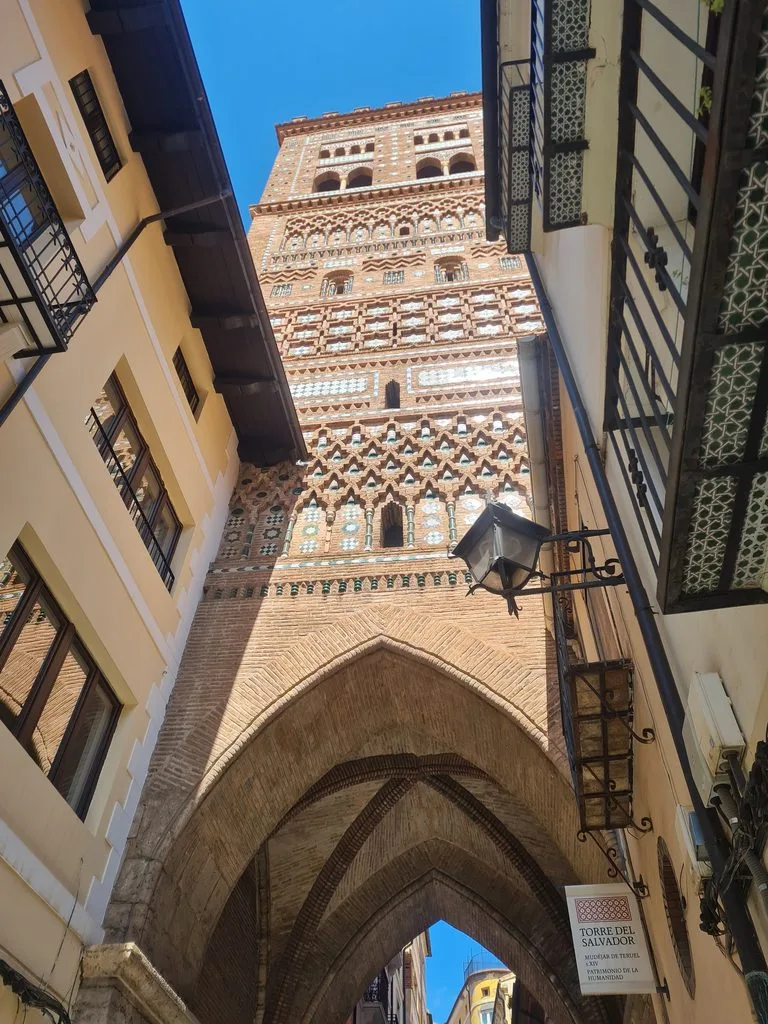
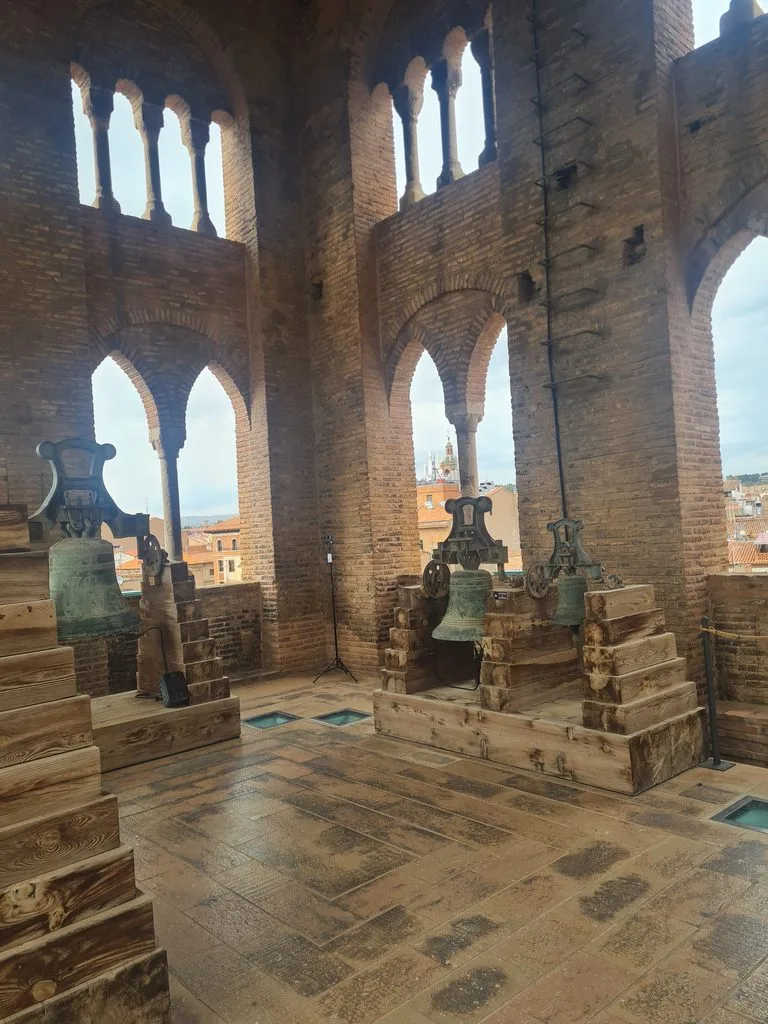
This 40-metre-high structure is the bell tower of the church of the same name. Its design is simple and the the building is well preserved. The tower, originally built in the 14th century, was rebuilt in 1677 following a collapse.
It consists of two interlocking towers, between which are narrow staircases. I climb them in the dark, up to a first chamber where I discover panels recounting the history of the building’s construction.
The information on Mudéjar art is clear and interesting. I find it surprising that the Christians had called upon the expertise of the Muslims to build their city. I learn, in particular, that according to legend, two Muslim architects, Abdalá and Omar, were competing to build the tallest tower. The winner would win the hand of a young woman. The second-placed architect finished the San Martín tower first but, when he discovered it was leaning, he took his own life. Abdalá completed the San Salvador tower, which was taller.
There are two further floors, each housing a visitor gallery. After exploring them, I reach the top of the tower where the bells are located. Through the beautiful windows typical of Al-Andalus buildings, I admire a plain and, in the distance, the mountains. I find it hard to work out which direction I cycled in during my journey.
Afterwards, I carry on exploring by foot. It does me good, as I’ve spent seven days cycling. Suddenly, I find myself in a large, quiet square, where the San Martín Tower stands, leaning slightly to one side. Here too, the Mudéjar style predominates. Its age makes it all the more appealing to me. Few monuments in Bordeaux, the city where I live, are as old as the Mudéjar buildings visible here.
The San Pedro Tower appears again by chance, just like the cathedral tower. Walking through a city aimlessly is, in my opinion, the best way to explore it.
Whilst waiting for my bus to leave at midnight, I eat tapas and drink wine in a bar to enjoy this very Spanish pleasure once more. Sitting at the bar, I look at my neighbours – a couple – and think to myself that this is a way of life. When boredom starts to get the better of me and I feel I’ve spent enough money, I step out into the darkness.
Back on my bike, I weave through the streets of the town centre, admiring the illuminated sights. I enjoy cycling at night in an unfamiliar town. I first did it in Milan, after my Warmshowers host cancelled. In Teruel, too, the lighting really brings out the beauty of the old buildings. The atmosphere is less hectic and more mysterious than during the day, as there are fewer people in this small town. What’s more, you can cover greater distances by bike than on foot.
I arrive at the deserted bus station. Teruel has surprised me with its beauty and tranquillity.
Which Spanish city surprised you the most? Have you ever seen any Mudéjar-style buildings? What did you think of them? Let us know in the comments!