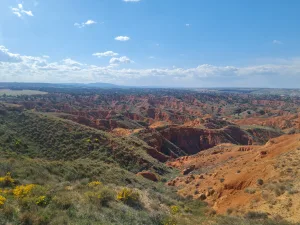
Even if you’re used to long-distance cycling trips, the Montañas Vacías – one of Europe’s most renowned bikepacking routes – requires careful planning and the right kit. Cycling 680 km with 12,000 m of elevation gain in a very sparsely populated region is no walk in the park.
Here are 7 things to know before you set off to make the most of your adventure in the Montañas Vacías.
There are several alternative routes
Around 80% of the official route consists of gravel tracks or forest paths. 20% are roads suitable for cars. Some of the climbs are difficult to tackle as they are very steep and the ground is rocky and rough.
Shortly before setting off from Teruel, I learnt of an alternative route that follows only the road. This loop is longer than the official Montañas Vacías route but joins in different places. This tarmac option serves as a fallback for cyclists who wants to avoid riding over large stones.
Furthermore, there are shortcuts at various points along the route. The final stage, for example, can be skipped to shorten the loop. There are other opportunities to cycle on quiet tarmac roads rather than on dirt tracks.
In short, the Montañas Vacías do not necessarily have to be explored via the main route but can be tackled ‘à la carte’, depending on the time available, personal preferences and physical ability.
You will find free mountain shelters
On the Montañas Vacías website, there is a map that can be viewed on Google Maps. It shows useful information, such as the locations of campsites, viewpoints and mountain shelters. The map shows around 10 shelters located on or near the official route.
These are free to use and open to everybody. You must leave them clean. In my opinion, the buildings are very welcome as they provide shelter from the cold and rain. What’s more, some are equipped with a table, bunk beds and a fireplace. The mountain shelters are relatively clean and there is often a pile of chopped wood in one corner.
Bear in mind that some refuges are not marked on the Montañas Vacías map. For example, I spent a night in one of these ‘secret’ refuges, which a woman had opened up for anoth cyclist and me. As a precaution, take a tent with you, as you may not find a refuge every night.
I particularly recommend the Collado Buey shelter. Firstly, because it’s located in a magnificent area covered in vegetation that forms patches of green, at an altitude of 1,700 metres. Secondly, this small stone building is beautiful and simple. Visitors can write a few words about their visit in a guest book. You can reach it after climbing a steep slope.
I’ve also seen lots of small, abandoned and partially ruined buildings. If you pitch your tent between their walls, you’ll be sheltered from the rain – or at least from the wind.

It’s possible to travel to the starting point of the Montañas Vacías by bus
The Valencia–Terruel–Zaragoza railway line has been closed since February 2025 due to infrastructure modernisation works. If, by the time you read this, this is still the case, you will be unable to reach the starting point of the Montañas Vacías by train.
Several bus companies, such as Bilmanbus and Samar, operate services to Teruel from many Spanish towns and cities. Ticket prices are around 15€ for a Valencia–Teruel journey and 40€ for an Irun–Teruel journey. The bike supplement costs around 10€ extra. You’ll need to remove a wheel and pack your bike in a bike bag or several bin bags.
The route was designed to boost the region’s appeal
“There is a place in Spain with an area twice the size of Belgium, with a population density similar to Lapland or the Scottish Highlands, only 6,99 inhabitants/km². It is the Spanish Lapland.”
This quote from Ernesto Pastor, the route’s creator, is displayed on the Montañas Vacías website. His aim is to fight reduce depopulation in his region.
According to the Diario de Teruel, several hundred cyclists from all over the world set off on the route every year. These adventurers have to stock up on food in the villages they pass through. Some stay in hotels. The newspaper even reports that travellers who have brought a tent with them prefer to stay in hotels to support local businesses.
During my trip, several shopkeepers told me that the villages were gradually losing their population and that the off-season is a difficult time. Furthermore, I saw many bars in the villages that were closed, either temporarily or permanently. I encourage you to stop off at the villages’ grocery shops, cafés and bars to support the locals and help revitalise these places.
Opportunities to stock up on supplies and recharge your mobile phone are rare
In this sparsely populated, rural region of Spain, it’s common to cycle for several tens of kilometres without seeing a single village. What’s more, in some of the villages you’ll pass through, there is nowhere to buy provisions or grab a bite to eat.
I therefore recommend stopping as soon as you spot an open shop or bar. It’s wise to always carry enough food in your panniers for your next meal as well as your breakfast, to make sure you don’t run out of supplies.
Furthermore, a power bank is essential. Without one, you risk being left without access to your mobile phone. Remember to top it up in the villages, even if it takes a while.

It can be cold at night
The best times of year to explore the Montañas Vacías are April to June, and September and October. In July and August, it’s too hot.
At the end of April, when I set off, the weather was fine and it wasn’t too hot. However, the temperature dropped at night, down to 8°.
Make sure you pack a warm sleeping bag and wear a top at night. Nights in mountain shelters will be more comfortable, especially if it has a fireplace.
There are many water sources
Every village has a drinking fountain. You can also sometimes find them out in the countryside. I recommend taking containers with a total capacity of at least 2 litres per person. That’s enough, given that there are plenty of opportunities to top up your water supply.
Bonus: Practical guide for a bike ride in the Montañas Vacías
Here’s what you’ll need to pack:
- Repair kit: patches, inner tube, tools
- Pump
- Lip balm
- Sun cream
- Camping stove
- Cooking utensils
- Waterproof and strong panniers
- Warm sleeping bag
- Inflatable mattress or groundsheet
- At least two water bottles with a total capacity of 2 litres
- Tent
- Lighter or matches
- Power bank
- Warm clothing: waterproof jacket, gloves, Lycra hat or balaclava
- Navigation device: GPS or an app such as Komoot
According to several websites, a gravel bike or mountain bike is a must. A gravel bike is versatile, but a mountain bike can be slow on tarmac roads. I set off on my Kalkhoff trekking bike fitted with 47 mm tyres – the official Montañas Vacías website recommends tyres of at least 40 mm. It worked well, but I did struggle on the rocky mountain tracks.
Have you ever cycled in the Montañas Vacías? What made the biggest impression on you? What advice would you give to bikepackers getting ready to set off?