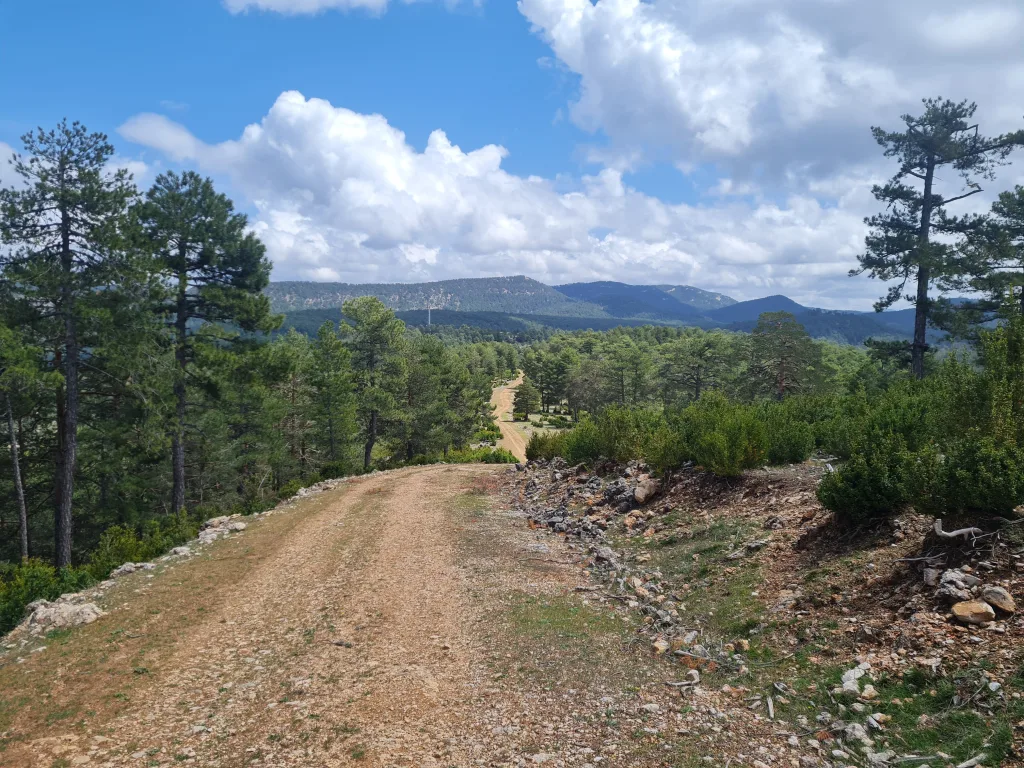
Four years after first hearing about the Montañas Vacías (the empty mountains) bikepacking route, I took the plunge.
I had to wait that long because I didn’t feel ready to ride the 680 km and 130 km of elevation gain of this loop starting from Teruel, in the mountains of central Spain. My interest in long-distance cycling trips grew through a series of adventures of varying lengths, ranging from a weekend in the Dordogne to a 600 km journey through Germany and Austria. Until the moment I decided to set off for a week in the Montañas Vacías at the end of April.
Find out what challenges, encounters and discoveries marked my journey in the nature.
Turning the “travelling abroad” mode on
I cross the border at Hendaye after a train journey from Bordeaux. In Irun, I rush to do some shopping in a supermarket because, as my train was delayed, I only have 15 minutes left before the night bus leaves for Valencia.
In the square, I can’t see a bus station, but there’s a bus parked there, with a driver and some passengers chatting in front of it. They confirm that it’s going to Valence. “Hurry up! We’re leaving in 10 minutes.”
I remove my front wheel and then pack the bike using 5 bin bags. The driver laughs: “That’s not a proper bag. You’ll have to go to Decathlon and buy one. It’s fine because it’s me, but normally you wouldn’t be allowed on.”
I think to myself: “What are you doing here? Why not have a more relaxed holiday, like most people?”
In the night that has just fallen, I can see through the window the balconies adorning the facades of a lit-up street. They are typical for Spain. I had missed being immersed in a foreign country; I’m going to keep writing for my blog.
The bus arrives in Valencia at 5.30 in the morning. I get back on my bike and pass a few young revellers who look as tired as I do. I head for Pepe’s house; he’s a cyclist I met on the Pirinexus who offered to host me.
A quick glance at my luggage rack: my groundsheet is gone. I turn back and search the ground for it. It must have fallen off as I rode up a kerb or over the cobblestones on the bridge. I feel disappointment and anger. I really must take better care of my things. After 10 minutes, I give up the search. There’s a Decathlon in Valencia that sells groundsheets.
Pepe welcomes me into his parents’ house, which has a large vegetable garden. It’s surprising and lovely to feel like I’m in the countryside when I’m actually just 20 minutes from Valencia city centre.
After visiting the town, I spend the evening with Pepe and his partner Lorena, over a tortilla de patatas. My host, an experienced cyclist, tells me about an alternative route through the Montañas Vacías that follows only the road. The official route seems too difficult to me in certain sections on rocky dirt tracks. The reason is that the route is recommended for gravel and mountain bikes, whereas I’m riding a touring bike. I save the road route on Komoot and will take it if necessary.
More than just cycling
The Montañas Vacías route forms a loop starting from Teruel, passing through mountains, forests and high plateaus. It was created in 2018 by Ernesto Pastor to help people discover little-known areas whilst supporting villages struggling with depopulation. It(s one of the least densely populated areas in Europe, nicknamed the ‘Spanish Lapland’. In just a few years, it has become one of Spain’s most iconic bikepacking routes. True to Ernesto Pastor’s philosophy, it encourages travellers to take their time, respect the places they pass through and prioritise the quality of encounters over performance.
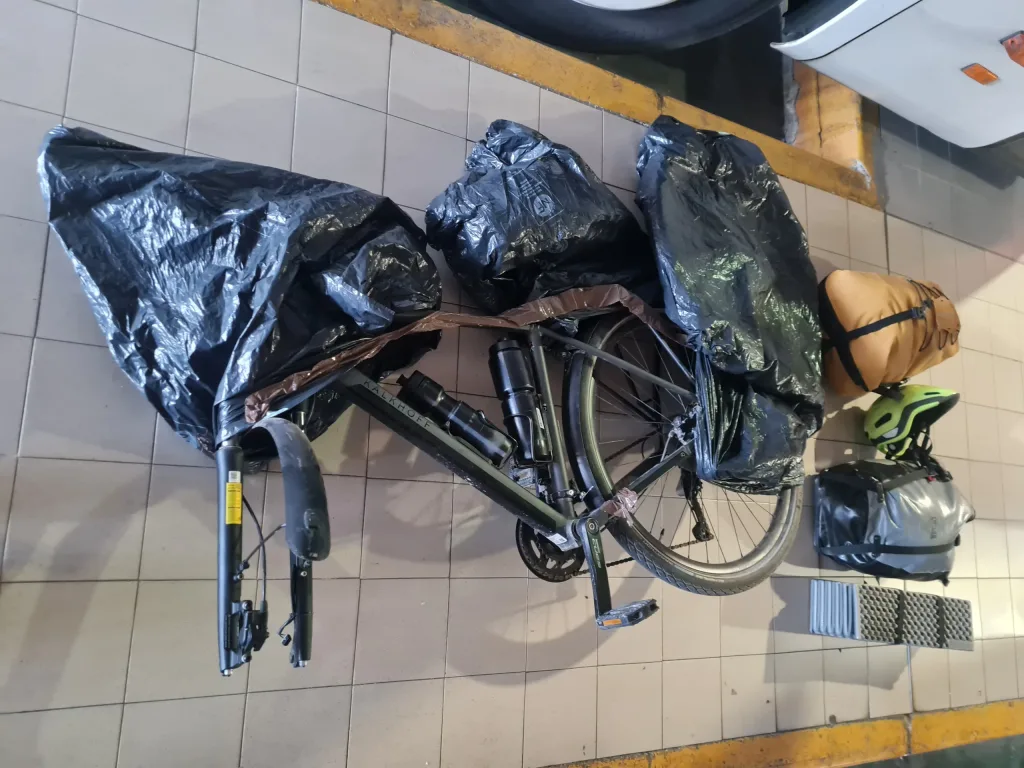
On the platform at Valence bus station the next morning, I can’t find the spring that holds a part of my front wheel in place—one I’ve just removed. Don’t panic. It must be here somewhere. I scan the floor, under the surprised gaze of the other passengers. There it is!
Just a few days or hours ago, under the stress that accompanies me day-to-day, I would have rushed about and got annoyed. This calm reaction shows me that I’m switching into holiday mode. Besides, I’ll need to stay organised and keep an eye on my stuff in my two large rack bags.
I board the bus to Teruel, this time without the driver making a comment about the bin bags. My cycling journey begins a few hours later, at the Plaza del Torico.
From Teruel to the Tagus: first climbs and a great encounter
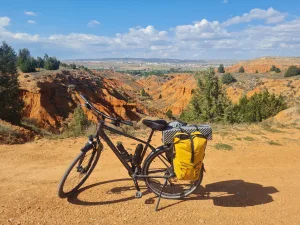
Stunning rock formations come into view on my right. They form a rippled landscape. I take a moment to admire these ochre-coloured mountains, which stand out against the blue of the sky.
My wheels roll along the ochre dirt track, surrounded by low-growing vegetation that smells wonderful. It’s a good thing it’s not raining, because if it were, the ground would be a quagmire. The climbs follow the descents.
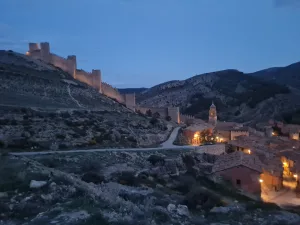
At 8 pm, I arrive in the village of Albarracín, 2 hours later than my schedule. I didn’t think the route would climb so much over these 40 km. The sun is setting over the town, which is one of the most beautiful villages in Spain. I stop for a picnic by the roadside, taking in the view of the village. Then I cross the Plaza Mayor, where a few people are having a drink on the terrace of a bar. The streetlights are already on. I dismount to push my bike through the narrow streets.
Following the route on Komoot, as I leave the village, I notice a house in ruins, half-built. The walls will shelter me from the strong wind. I pitch my tent outside, in the dark, where the walls meet at an angle. This elevated spot allows me to admire the village lights and the 15th-century wall built by the Catholics.
Next, I throw my things haphazardly inside the tent, whose canvas flaps in the wind. Over the next few days, I’ll have to stop cycling earlier to enjoy a more organised evening’s rest.
At 2am, the cold wakes me up. I’m in a T-shirt and shorts inside my sleeping bag. It must be 7 or 8°C. I lie awake for an hour before sleep finally takes me.
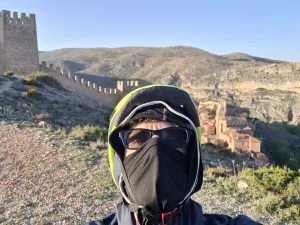
Waking up at 7am to the sound of my phone’s alarm is a struggle. I force myself to go outside despite the cold wind that’s still blowing, to make some tea on my stove. The drink revives me. Getting up and packing my things into my panniers, now secured to my luggage rack, makes me feel proud.
Let’s try to follow the main route through the Montañas Vacías, even if it’s difficult. A few minutes later, I have to get off and push on a winding climb along a track covered in large stones. I push hard with my legs to move my bike forward as it jolts along. Even on a gravel or mountain bike, I’d struggle.
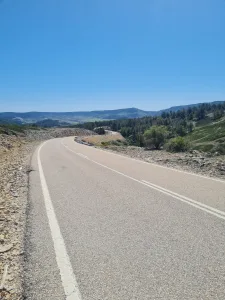
I give up at the second bend and join the road for cars. The ride is pleasant thanks to the smooth tarmac and the almost complete absence of vehicles.
The terrace of a bar-restaurant on a village’s town hall square invites me to take a break. A small van pulls up and locals approach to buy bread. Inside the bar, where I’m charging my mobile, some men are eating a savoury meal at a table. Given the early hour, it must be the almuerzo, the snack taken between breakfast and lunch in Spain. The waiter I’m chatting to tells me there are fewer and fewer people living in the village: 30 inhabitants according to him.
At the Nacimiento del Tajo (the source of the Tagus), I join the official route. I’ve just taken quite a shortcut. I don’t mind covering fewer kilometres than planned. The most important thing is not to force myself to cycle for long stretches on rough, rocky dirt tracks. However, from now on, I plan to take the dirt tracks to explore deserted, unspoilt areas.
Let’s see what the Tagus looks like at kilometre 0. It’s just a rather ordinary pond. I hear a loud, continuous noise getting closer as I walk towards the small body of water. It’s the frogs living there that are making the sound. There is a large monument depicting a sort of knight to mark the river’s source.
Back in the saddle, I cycle along a clear forest track. Vast pine forests cover the Montes Universales mountains. As the path climbs, I pedal without straining, just as I’d told myself I would when preparing for the trip.
In a moment of intense effort, I start humming the words to a song from my choir and stop because I can’t remember them. I have to work out the rest for myself. I stop thinking about the slope I have to climb and simply enjoy the moment.
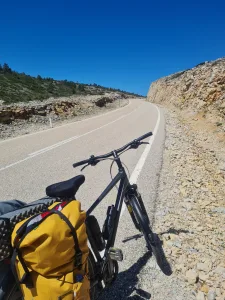
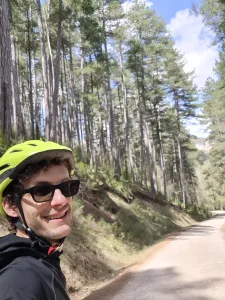
Shortly after entering Castilla-La Mancha, I arrive in Checa, the largest village since Albarracín. I veer off the route to find a mountain hut marked on Google Maps. It’s nestled in a beautiful spot covered in pine trees. A Spanish bikepacker is taking a break, sitting at a table. Inside the refuge, there’s an unpleasant smell of a log fire and flies are buzzing about. It doesn’t appeal to me.
However, on the long descent after Checa, I regret not having stopped. I don’t know when I’ll find another place to pitch my tent, whereas my aim was to set up camp early to enjoy the evening.
In the next village, I see a cyclist stopped by a fountain. His bike and luggages suggest he’s on a long-distance trip.
– “Hello there!
– Hey! Are you French?”
Surprised by this immediate interpretation of my accent, I laugh.
“Do you want to sleep in that refuge tonight with me? I asked a woman in the village and she’s going to open it.” I agree without a second thought.
Florient comes from Quebec and is 21 years old. He has just spent two years travelling by bike, from Montreal to Colombia. Before heading home to start his studies, he decided to cycle from Madrid to Brussels. So he’s not a bikepacker exploring the Montañas Vacías.
Undertaking this journey at such a young age is a sign of maturity. He had to fend for himself, which taught him a great deal about life, surely more than if he’d spent those two years studying. I think it’s smart to do this at this age. I’d like to do the same to discover different cultures and meet people from abroad, but also to have adventures.
Over dinner, we chat about our cycling trips. His kit is more sophisticated than mine and I’m keen to see what he’s brought with him, from cooking utensils to his inflatable mattress. I’m delighted to have met a very friendly and cheerful cyclist, who describes himself as a hippie. On the menu tonight: my hard-boiled eggs as a starter, then his Chinese noodles cooked in my miso soup, and finally my cheese served with his bread.
As I set up my sleeping bag in the large, clean and comfortable refuge, my gaze falls on the fireplace: “It would be nice to light a fire…”
We gather twigs and some hay that’s already been cut. Florient’s method—which involves building a pyramid of hay, then placing some cardboard he found in a corner of the hut on top, before covering it all with twigs and logs—works a treat. I drift off to sleep as I watch the flames dance and listen to the crackling.
In the morning, we have breakfast at the table inside because it’s cold outside. Florient’s porridge adds a bit of variety to my meal. When we’re packing up, I can’t find one of my gloves. It annoys me that I’m so scatterbrained. This loss is also down to the fact that my clothes and accessories are all crammed into my Vaude bag, with no organisation whatsoever. Next time I go on a cycling trip, I’ll need to get some small bags to keep things separate in my pannier.
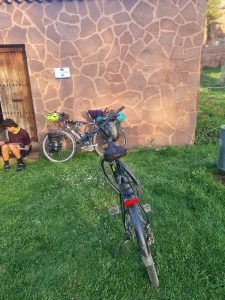
After saying goodbye to Florient, I head back onto the road. As the Canadian told me, it climbs steeply. I make my way up in a zigzag pattern. This gives me time to admire the pine trees, one of my favourite types of tree.
At around 9.30 am, I arrive at a village where there’s a shop with tables and chairs set out in front. The owner is chatty. Originally from Catalonia, she’s lived here for 20 years: “There’s nothing better than nature.”
She tells me that many cyclists ride through the Montañas Vacías, but I’ve only come across two since I set off. Further down the road—which is now a dirt track—the Spaniard I saw yesterday at the refuge catches up with me. He’s from Bilbao and is on a trip lasting a few days, following the ‘Castle Route’, an alternative route through the Montañas Vacías. I’d like to chat with him, but he picks up the pace to get back into his usual rhythm. I watch the taciturn cyclist ride off on his gravel bike.
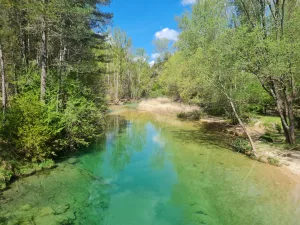
The track runs alongside the Tagus, whose turquoise, blue and green reflections I admire. During the journey, I try to live in the moment without thinking about how to describe the events and surroundings in writing. It’s tempting to imagine how I’ll recount the events. On the other hand, writing helps me to be more attentive and curious about my surroundings.
On that note, as I decided during my preparations, I stop from time to time when something catches my eye, such as a plant with a delightful scent, an information board about a local feature, or a beautiful landscape. However, these stops are few and far between as my aim is to finish the full tour in 7 days. Since setting off, I’ve been cycling about 70 km a day. This pace isn’t enough to cover the entire route in seven days.
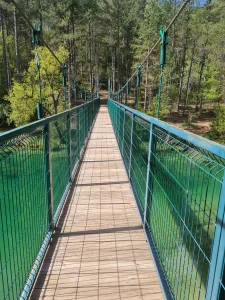
Suddenly, a bridge appears over the river, which is more of a stream at this point. A photo of this structure features in the Lonely Planet guide that first introduced me to the Montañas Vacías. The wooden structure shakes under my weight. It’s just wide enough for me to get across. I’m overcome with joy at having reached this stage.
During my picnic break, I can’t find my Swiss Army knife. I’m disappointed and saddened. It’s crazy how the loss of an object of such little monetary value can affect me. Knowing that it has accompanied me on my travels for several years, it has great sentimental value, but I hadn’t realised it until now.
I’d planned to go for a swim in the Tagus, but I’m not in the mood after this mishap. Besides, I mustn’t stop for too long if I want to cycle far enough before sunset.
The track climbs higher. I admire the river, the massive rock formations and the vast expanse of greenery formed by the trees.
From the Tagus to the Serrania de Cuenca: unexpected detours
Just a few more kilometres to Zaorejas. A tarmac road winds its way uphill. I climb it, zigzagging along. As I round one bend, another appears at the end of the straight. The climb seems endless. Turning my head to the left, I can see the spot on the road where I was just a moment ago. It seems so far away! In the vast plain, stretching as far as the eye can see, there must be no more than a dozen people living here. The sight reminds me of Texas in the days of Davy Crockett. It is a vast expanse of nature, barely touched by human hands.
Zaorejas is smaller than I imagined, but I’m starting to get used to the feeling. I pass an elderly man who seems surprised to see me. The bar I’d spotted on Google Maps is closed. Outside a hotel-restaurant at the entrance to the village, an employee tells me they serve sandwiches. Brilliant! Inside, four people are chatting at the bar, with the TV news playing in the background. The size of the place seems disproportionate to the likely number of customers. In the dining room, the large window offers a panoramic view of the natural surroundings.
I eat a hearty ‘tortilla francesa’ sandwich, washed down with a Coke, whilst watching the news on TV. It’s going to rain over most of the country tonight and over the next few days. Consequently, I decide to head for a mountain refuge, 20 km away, as today’s destination.
After the customers have left, I chat with the waiter whilst he’s having lunch at a table in the main dining room. “In the summer and at weekends, there are quite a few people, but the rest of the time it’s tough. There are fewer and fewer people living here.” I admire him because I couldn’t live in such an isolated place.
– “Where can I buy a spoon here?”
– “A spoon?”
He says nothing and disappears to the back of the room. He returns with a smile, a spoon in his hand, and refuses to be paid. Florient is right to ask for help from the people he meets. You have to give it a go.
With a full stomach and my batteries recharged, I set off again. Instead of following the route of the Montañas Vacías, I carry on riding on the tarmac. Partly to save time, and partly because I love riding on long, clean road stretches with very few cars, even if it’s uphill.
On the official route, a forest track winds its way into the vegetation. My wheels struggle to make headway on the path, which is sometimes very rocky. My knee still doesn’t hurt thanks to my knee brace, but I’m feeling tired. Suddenly, I see three or four does bounding away. It’s the second time since I set off that I’ve come across this animal.
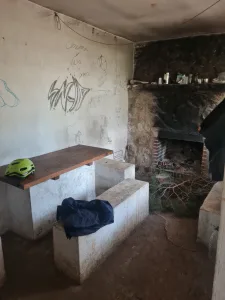
The refuge is divided into two rooms, each containing wooden bunk beds and tables. I can hear a faint crackling sound coming from the fireplace. People must have slept here last night. On the mantelpiece, there is salt, coffee filters and olive oil. On the wall, I can see the names left by cyclists and hikers who have passed through here.
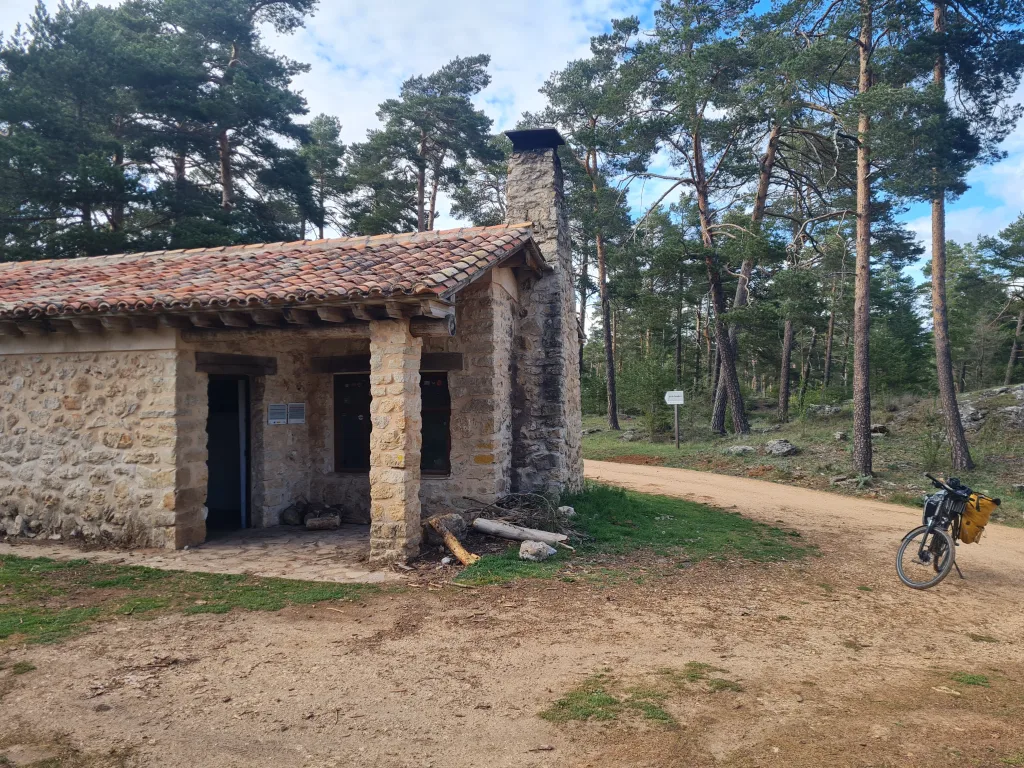
I’m delighted to be in this welcoming spot and want to make the most of my evening before sunset. First of all, I need to sort out something to light a fire with. There’s a pile of wood outside against the building—a mix of branches and pine logs—but I gather some more branches from the pine trees surrounding the hut so as not to use up too much of the supply.
My dinner consists of miso soup, tinned lentils and a clementine. During the meal, which I eat with a spoon this time, the silence is broken only by birdsong and the sounds of small animals.
Inside the refuge, I feel a sense of fear because the place is large and empty. It is both comfortable and welcoming, yet also unsettling. I banish the negative thoughts and set about lighting a fire. It catches quickly, thanks to the cardboard I found on one of the bunks and the pine needles.
I prefer to sleep on the floor rather than on one of the bunks because of a bad memory. A few years ago, I caught bedbugs in a refuge in Corsica, on the GR20.
My alarm goes off at 5.45 am. My aim is to cycle 130 km today. I enjoy heating the water for tea on the stove sitting on the relatively clean table and spreading jam on the sliced bread. Fifteen minutes later, my battery is flat, even though my phone was in flight mode. If I were to run into trouble here, I’d have no way of calling for help. The path splits in two. There’s a signpost there, but it doesn’t have a map on it.
Right or left? I choose the second option. I can always retrace my steps if the path leads nowhere.
Shortly afterwards, I see a tarmac road. That’s a good sign, as it must lead to a village. The next place on my route was Valsalobre, but a sign points to Peñalén. I should have turned right.
There’s a bar, but it’s closed at this time of day. I’m torn about whether to wait for it to open, probably at 9.30 am, to charge my phone. Besides, I’m furious at wasting time when I got up so early.
While taking a walk, I come across someone for the first time, an elderly man. “Hombre!” He repeats the word several times. He tells me there’s another bar on the other side of the village but that it’s surely closed. I curse him inwardly because he didn’t offer to let me charge my mobile at his house.
Next to the bar, which is indeed closed, a map of the region is displayed on a bus stop. The road leads to Cueva del Hierro and then Beteta. The latter is on the route, as far as I can recall.
I’m cycling at full speed down the long descents, which fills me with joy. The sign for Beteta is in sight. A hotel stands by the roadside and, on the other side, a cluster of houses. I carry on straight ahead to a petrol station. It reminds me of the US Army outpost just before the start of Indian territory in the film Dances with Wolves. It’s the last place I can stock up before entering the vast Serrania de Cuenca Natural Park.
Inside, a woman wearing an orange waistcoat is serving two men behind the counter.
– “Can I have a coffee?”
– “Yes, of course.”
The shop assistant is very friendly. She lets me charge my mobile phone and my power bank. “We get lots of cyclists from the local area, and visitors from further afield too.” That’s not what I’ve noticed. I take a break, watch the news on TV again and buy some provisions. I’ve got 110 km left to cover today, much of it through the wildest countryside. Let’s go!
My bike jolts over the bumps on the forest track. I grip the handlebars tightly. This bike is reliable and sturdy, and its tyres are almost puncture-proof. It’s more comfortable than a gravel bike because of the handlebar position, which allows me to sit upright.
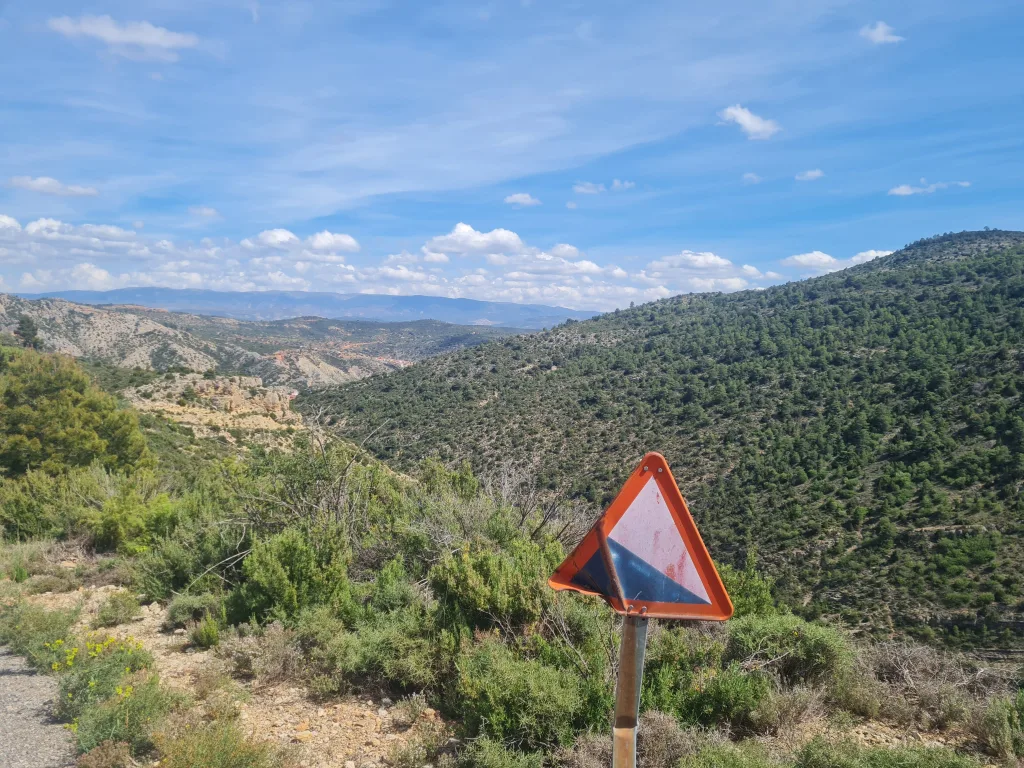
At a stop, I realise I’m not on the right track. You must be joking! I’ve seen very few junctions since Bateta. The exact route is nearby, but I don’t want to turn back and climb the hill I’ve just come down.
Komoot tells me that a path joins the track further on. My wheels struggle to make headway on the stony ground and, on the climbs, I have to get off and push my bike because the stones are too big.
Where the path is supposed to veer off to the right, there’s nothing but grass. So I decide not to leave the track. It veers away from the official route but joins a tarmac road. I’m fed up with these rocky dirt tracks that are so hard to ride on.
Another 10 km to go under the sun until I reach the road. The ground is rough and the climbs steep. I get off and use my arms and thighs to push my bike. Suddenly, I spot a small bush 20 metres away. It’s an achievable goal. Think of nothing else but that, forget the rest of the climb. I lower my head and encourage myself to keep going, whilst looking up to see my goal. Goal achieved!
Next, a tree with damaged branches catches my eye. This sight spurs me on without a second thought. I carry on like this for several hundred metres. The mental strain is less intense when tackling the climbs this way.
I’m exhausted. Will I manage to reach Teruel in time?
Still no sign of anyone. On the climbs, I admire the wooded mountains of the Serrania de Cuenca and the plants growing by the side of the path, which give off a delightful scent. I think I can smell thyme.
Suddenly, the road for cars appears, further down. A motorbike is riding along it. After cycling without meeting a soul, seeing another human being gives me a strange feeling. When I reach the end of the path, I discover a refuge. I sit down at a table to have lunch. I’m delighted to be taking this break surrounded by shrubs, in complete tranquillity. I recharge my batteries and reply to messages from my loved ones on WhatsApp.
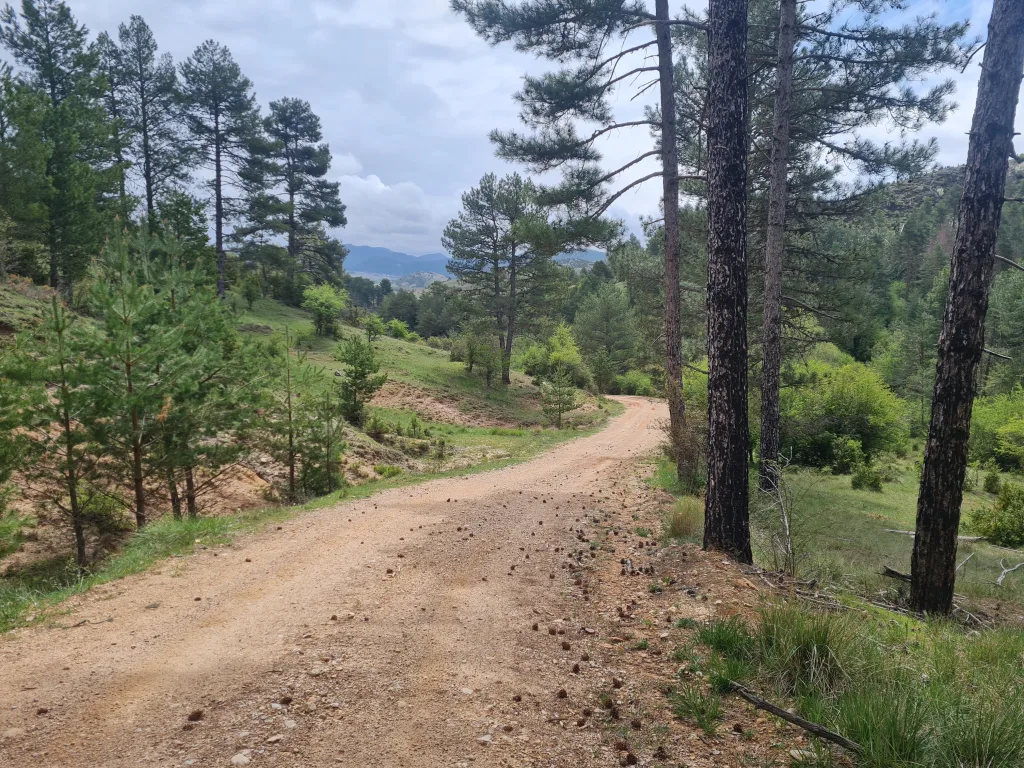
Then everything happens very quickly. The tarmac road slopes downwards. I pass through two villages before joining the official Montañas Vacías route. This follows a road for cars until Beamud, which marks the end of the Serrania de Cuenca.
As in many villages, there’s no one on the streets and the bar is closed. As I leave the village, I feel drops of water on my arms. The rain is getting heavier. I take shelter under a large tree by the side of the road. Suddenly, I hear the storm rumbling.
I hurry back to Beamud, in the pouring rain. At the end of a street, a small wooden hut with the word ‘botiquin’ above it comes into view. I push open the door of the structure. There is nothing inside except a small table, and the place is big enough for me to lie down.
This hut is a godsend. According to Google Translate, a ‘botiquin’ is a place where medicines are stored, but there are none here. I decide to spend the night here, as it looks set to rain all night.
In the evening, I go out for a picnic in a small square. There’s still no one around, which creates a rather gloomy atmosphere. I would have liked to do some shopping, if only to support the local shops, but there’s no grocery store.
From the Serrania de Cuenca to the pico Javalambre : pushing my limits
By 7am, I’m already in the saddle. As rain is forecast for the coming night, my goal for the day is to reach a mountain refuge, specifically the one known as Collado del Buey, about 130 km from here.
On the tarmac road leading uphill, I hear only birds and, from time to time, the sound of a car. What a joy to cycle in the morning sunshine! In Huerta del Marquesado, a surprising factory or warehouse greets me around 9.30 am. Big trucks are coming and going from the large building.
I look for a bar to grab a bite to eat. One seems to be closed, and Google Maps tells me there’s another one nearby. Inside, I find a man and a woman standing amongst the tables, on which chairs are piled up.
– “We’re closing down for good.
– Oh, sorry. Is the bar at the back open?
– No, that’s closed too. The only one left is at the entrance to the village.”
I stop for a break at the bar opposite the factory. Just as I walk in, a group of workers wearing orange vests come in. They sit down and order beers and sandwiches for their mid-morning snack. For my part, I have a ham and tomato sandwich, along with a coffee and an orange juice, whilst my phone is charging.
On the wall, I see corrida swords and old bullfighting posters. There is also a framed photo of several people sitting in what looks like a corrida arena a football stadium. It must date from the 1990s. They are surely members of the family who run the bar. An elderly woman in a chef’s uniform pops out of the kitchen from time to time to chat with the two waiters, who must be a father and son. I leave this no-frills place with regret.
An hour later, I arrive in another village. Two men are chatting in the street.
– “Is there anywhere I can buy something to eat?”
– “Yes, but it’s closed. They’ll serve you sandwiches here.”
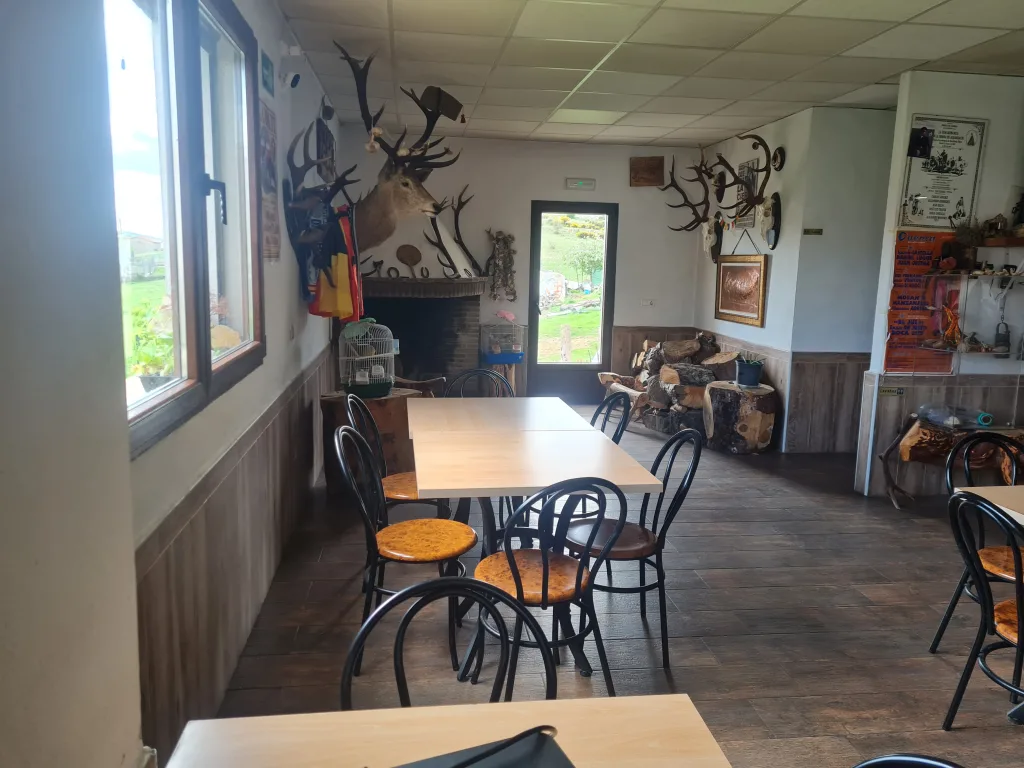
I turn around and see a large restaurant behind a car park. Inside, several stuffed deer heads and numerous bullfighting posters form part of the décor. I’m in the heart of rural Spain.
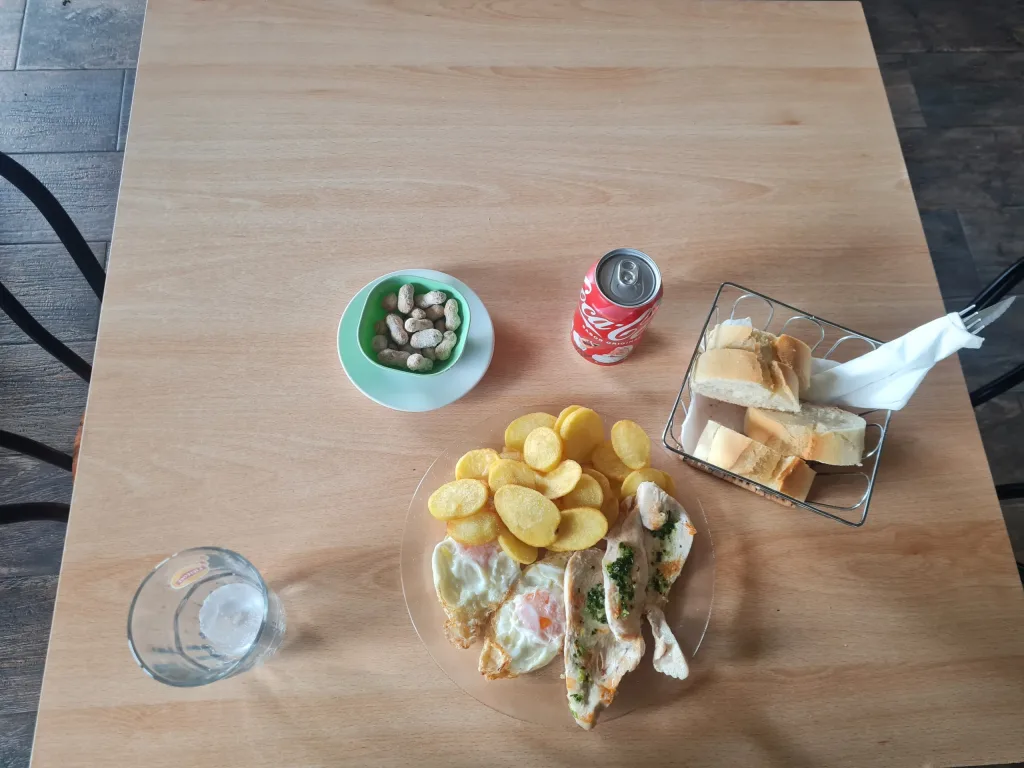
I eat again. Who knows when I’ll come across another village. This time, it’s eggs, chicken and chips. Even though I’m a vegetarian, I’m allowing myself to eat meat on this trip to enjoy Spanish cuisine. The friendly waitress makes me a tortilla sandwich and packs a banana to take away. According to her, there are more cyclists around during the May bank holidays, which start tomorrow with the 1st of May.
After that, I don’t see a soul or pass through a single village for several dozen kilometres. Various species of pine cover the mountains. I try to savour the moment, telling myself how lucky I am to be able to see this. What’s more, when I see the information boards in the various protected natural areas, I sense a desire to preserve these places and to welcome tourists.
The people who live in this harsh and isolated region show that a different way of life is possible. They live on the fringes of what society tends to offer us. They are, in a way, rebels. Moreover, I find that the locals I meet are direct and gruff, yet friendly.
I’m now cycling along dirt tracks. On the descents, I pedal hard and take care not to slip on the stones. I suddenly spot a beautiful fox moving through the trees. It looks just like the image I have of this animal: small, red and with a thick tail.
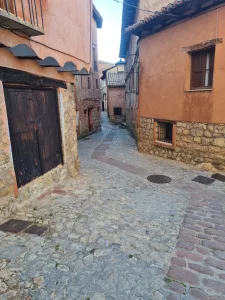
A tarmac road leads me to a village clinging to the mountainside. On the steps, I have to get off my bike. In the sun-drenched square in front of Castielfabib’s town hall, I spot a sign saying ‘Tienda’. The shop is closed, but a man walks inside and is greeted by the shopkeeper. “Take whatever you like,” the shop assistant says to me as he spots me at the door. Phew! I buy tinned lentils, sliced bread, apples and biscuits.
In Torrebaja, I check how far I still have to go. According to Google Maps, it’s a three-hour walk to the refuge. It’s 5 pm and night falls around 9.30 pm. However, the Komoot map tells me that a long, steep climb is about to begin, and Google Maps doesn’t take into account the fact that I’m carrying at least 30 kg of luggage.
The rocky path winds its way through the mountains. Once again, I say the names of the trees I see along the track out loud, so as not to think about the climb. After an hour of climbing, I stop to rest, have a drink and eat some biscuits. I’m careful to take only one or two sips, as I’ve only got 750 ml left and there’s almost no chance of finding a tap in this remote area.
I’m not sure I’ll make it before nightfall. If night falls before I reach the refuge, I could pitch my tent.
As I gain height, I admire the surrounding mountains, some of which are ochre in colour. On the steep slopes, which I climb at a slow pace, I thank my friends in Bordeaux out loud for who they are. After cycling in the sunshine along the uncomfortable, uneven track lined with almond trees, I reach a less rugged dirt track in the Puebla de San Miguel Natural Park. Maps tells me I’ll arrive in an hour.
The final climbs seem endless, though they can’t be more than 200 metres. I feel my vision blurring and my strength failing. “Stay focused, take your time, don’t wear yourself out.” I lower my head.
At the end of a stretch covered in large stones, where I walk, I see a wooden sign: “Refugio Collado del Buey”.
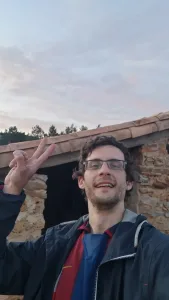
A building comes into view in a treeless area. What a joy and what a sense of pride! I try to send a selfie to Pepe, who recommended this refuge to me, but I can’t because there’s no signal.
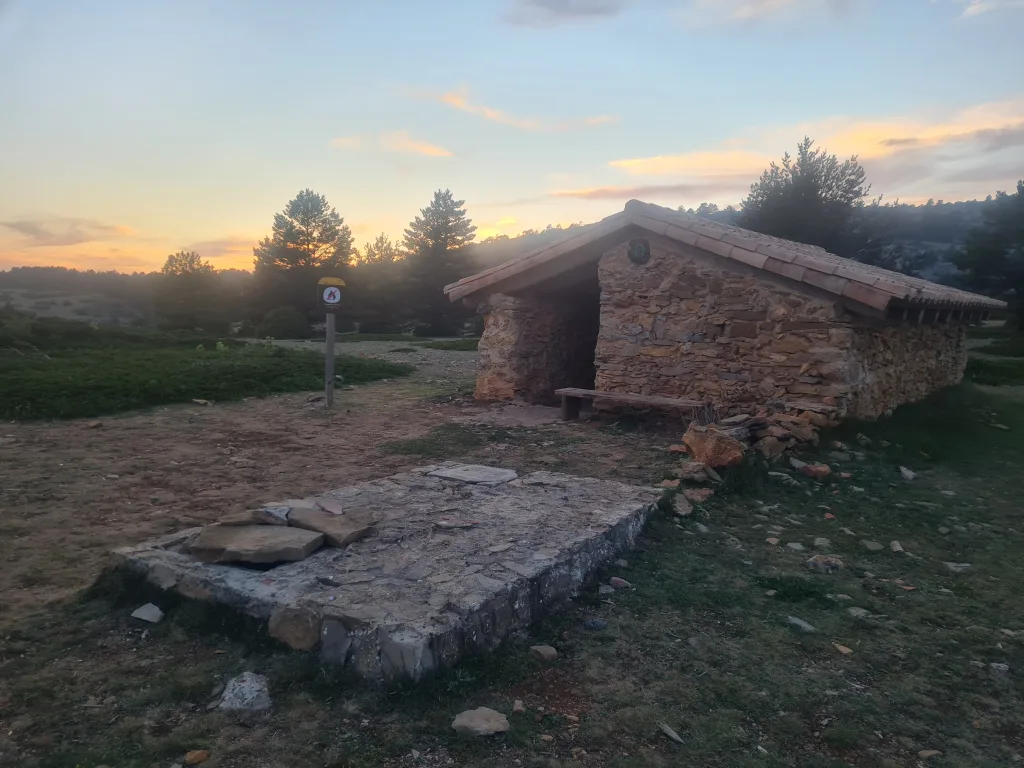
The refuge is small, beautiful, and clean. Making a fire is forbidden. I only have the strength to lay out my groundsheet and sleeping bag, then eat my sandwich and banana as the last rays of daylight fade. I’ve rarely pushed my physical limits so hard.
I go outside a few minutes after lying down because I must be too excited to sleep. Looking up, I see the stars, numerous and looking much bigger and brighter than in the city. They seem very close. “Nature is beautiful” are the only words that come to mind.
The next morning, I treat myself to the luxury of a lie-in, as today’s stage is short. It didn’t rain during the night after all. The refuge sits amidst unusual vegetation I’d already seen on the first day of my journey: small shrubs forming patches of green.
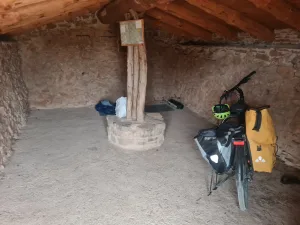
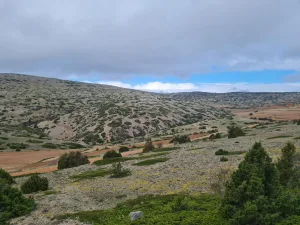
Lying on my sleeping mat, I read the guestbook containing messages written by people who have passed through here. Most of them are Spanish hikers. They recount their adventures and leave words of thanks. I write a few lines in this ‘guestbook’.
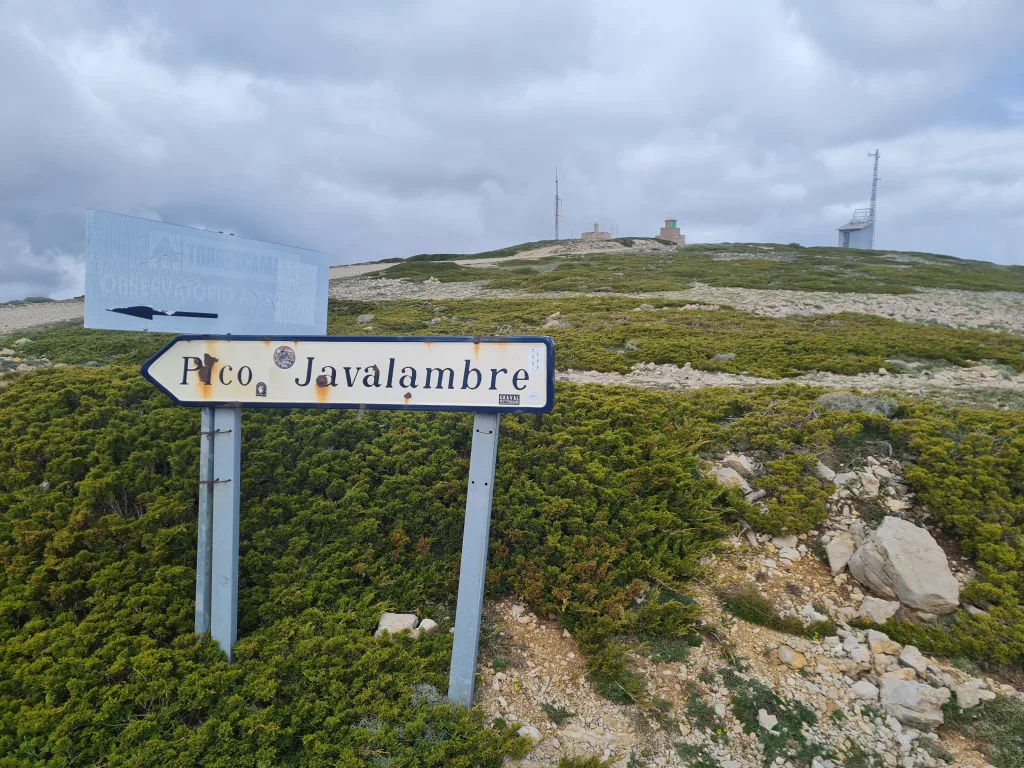
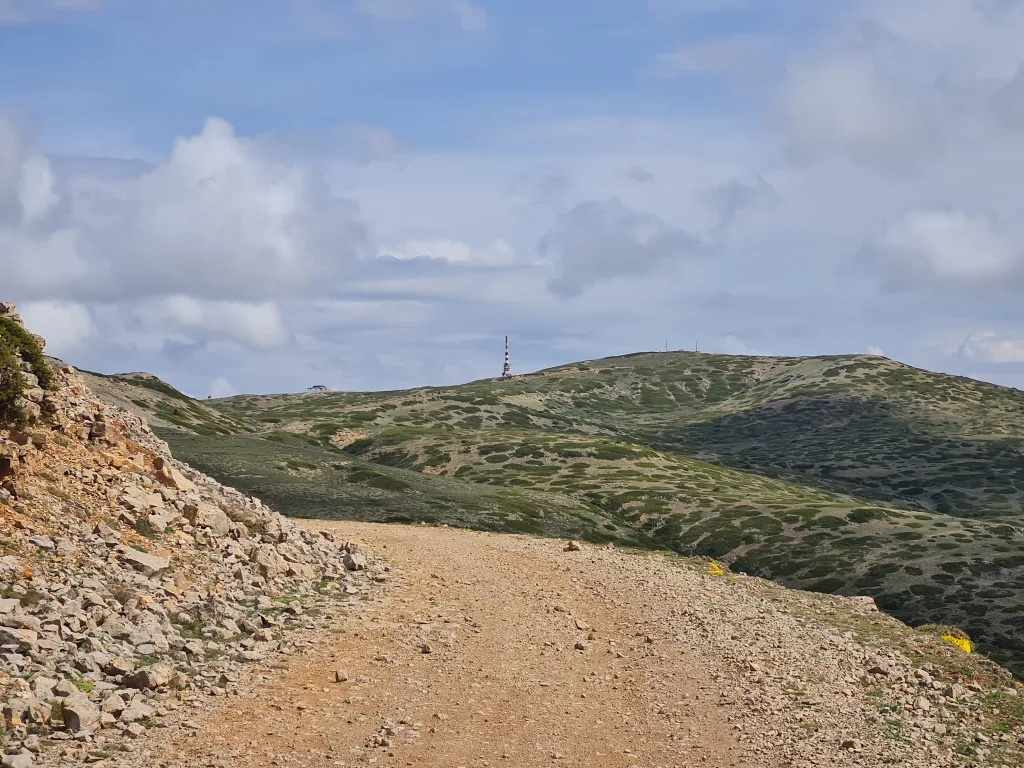
The first goal of the day is Pico Javalambre, at 2,020 m, 300 m higher up. Throughout the climb, green cushions cover the ground around the track. The track is rocky and rough. The coolness of the altitude is noticeable and the scenery reminds me of the moon.
On the descents, my bike jolts over the large stones. Some rivets on my small pannier have come loose under its weight, but the pannier itself holds firm.
Suddenly, I spot a red and white antenna: Pico Javalambre. I don’t stop for a picnic as I’d planned because the place is buffeted by a strong wind and cold. Having covered 130 km yesterday, crossing this pass seemed easy. The human body is amazing. It can adapt and achieve things we never imagined.
From the pico Javalambre to Teruel: a difficult return to the hustle and bustle of city life
A long descent begins. Some sections are tarmac. I’m delighted to give my thighs a rest. It’s my concentration—to make sure I don’t fall—that’s working the hardest.
During a stop, I plug in my power bank, but once again, nothing happens. Yet I’d charged it at the petrol station. I’ve only got 10% battery left on my mobile. This kit is rubbish! I’ll complain to Fnac.
As a result, I no longer have access to the map. This is a problem in the area around La Puebla de Valverde, the last village before Teruel, where I want to take a break. In an area by the side of the motorway, I approach a passer-by.
– “Where is La Puebla de Valverde?”
– “It’s right here!”
– “Where can I get something to eat?”
– “At the service station, just over there. There’s a good, reasonably priced restaurant. Where are you from?”
– “France.”
– “Ah, France! What I love about the French is that they’re proud of their products and their culture. In Spain, we’re not good enough at that. 95% of people are good, but the politicians do nothing.”
I don’t understand what he’s referring to, but I nod in agreement. I ignore his advice and cross the motorway to head into the village centre. A crowd is blocking access to the main street and loud music is blaring from a loudspeaker. I weave my way through the groups of people, almost all of whom have a beer in their hands. They look happy to be there. This festival must be a May Day tradition.
Two locals recommend the Taberna de Amparo to me. The sound of music from the street and the chatter in the restaurant bother me, as I’ve grown accustomed to the silence of the mountains. However, I’m delighted to rest, enjoy a good meal and charge my mobile phone in this cosy spot. I’m served patatas bravas and a torrezno, a typical Aragonese dish made of very salty smoked bacon, served with tomatoes. A delicious cheese tart rounds off my meal.
The final stage is 160 km long and includes a mountain pass over 2,000 m high. However, I want to spend tomorrow afternoon in Teruel to visit the town and write some postcards before boarding my coach at midnight.
Consequently, I decide to reach my destination tomorrow morning by taking a 30-km shortcut along the Los Ojos Negros greenway. I will therefore have cycled less than 600 km, but I could have covered the full route with an extra day. A French cyclist, whose account I had read in *Las Montañas Vacías*, had completed the journey in eight days.
My day’s cycling is over. Let’s find somewhere to sleep. First, I take shelter from the rain under the porch of a church, where I sit on the ground to read 24 Hours in the Life of a Woman by Stefan Zweig. It’s a pleasure, as I’ve read very little since the start of my journey due to fatigue.
However, a feeling of sadness comes over me. It’s due to the falling rain, the absence of people on the streets, and the fact that I’m no longer surrounded by nature. Even though the rain is forecast to stop at 10 pm, I’d rather not risk getting soaked in my tent in the middle of the night.
As I leave the village, I spot a building wedged between a railway line and a building site. The house is abandoned, but its small terrace is open. There’s just enough room for me to lie down here, if I move aside what must be a blanket or some kind of protective covering for the building work.
The night is difficult because the place smells bad and I’m cold due to the draught blowing across the terrace. What’s more, the lights from the village are bothering me. Unable to sleep, I watch pointless videos on my phone. When I wake up, strangely enough, I’m not cold and find it hard to get out of my sleeping bag.
The Ojos Negros greenway is smooth and flat. I admire the cloudy sky and the mist, which create a very charming backdrop. Suddenly, I see a doe hopping about. She vanishes, then three or four others appear and move in the same direction as me. I follow them, filming them as I go, until they are no longer visible.
To make the most of my final moments in the countryside, I slow down and take in my surroundings. I also download a plant identification app and stop to identify the plants and pine trees lining the path.
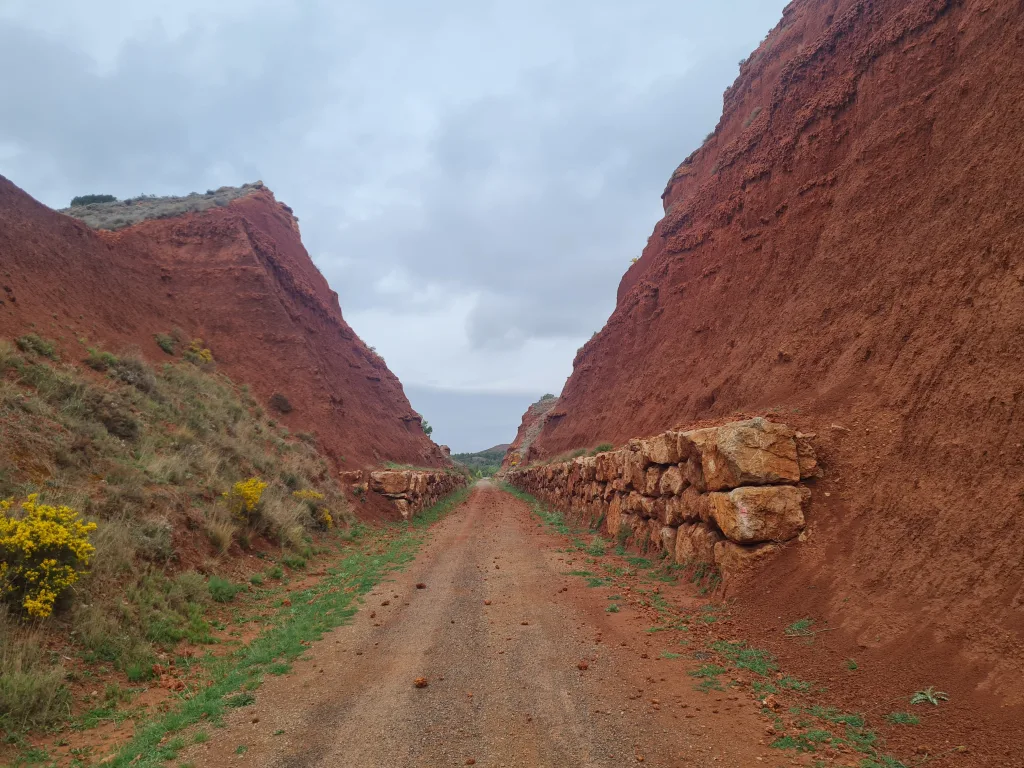
I’m now cycling across a stunning ochre landscape. On either side of the track, small ridges form a canyon. It feels as though I’m in the area with the folded mountains I spotted on the first day.
Around 9am, I arrive in Terruel, on the Plaza del Torico. I pop into a café to rest and write about the previous day in my notebook. I’m proud of what I’ve achieved, but I would have liked another day to explore the final stretch of the Montañas Vacías and enjoy the countryside a little longer.
What about you? Have you ever cycled through the Montañas Vacías? If so, what memories do you have of that trip? If you’re thinking about doing this trip, are you going solo or with other people? Tell me in the comments!