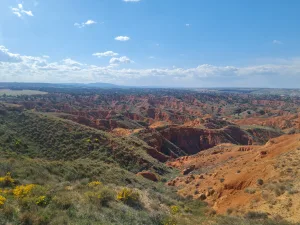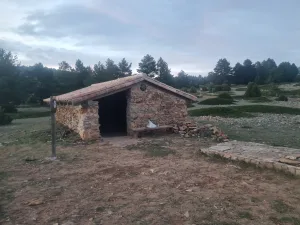
What I love about long-distance cycle touring is, first and foremost, the feeling of total freedom and independence. It also boosts my self-confidence as I push myself physically, and at the same time, cycling for several hours a day helps me relax and reflect. Finally, it’s a way for me to immerse myself in an unfamiliar region and try to understand the way of life of its inhabitants.
However, this hobby takes a lot of time and good organisation, particularly as I travel to the start and finish points by bus and train.
In this article, I explain where I’m at with my preparations, less than a week before the start of my trip to the Montañas Vacías in Spain.
A ride to prepare body and mind
Sunday morning, 8am. I’m having breakfast at home whilst admiring the blue sky through the window. The weather is perfect for a bike ride. The ride ahead of me in the Entre-deux-Mers region, near Bordeaux, is designed to help me get used to the numerous steep climbs I’ll face in Spain.
At the end of Victor Hugo street, where the shops are coming to life, I reach the stone bridge. Despite the sunshine, I can feel the winter chill in my hands.
There are lots of joggers and cyclists. Most of the cyclists are on road bikes and overtake me like Formula 1 cars on a race track. Seeing so many amateur athletes brings me joy and motivates me.
The Île d’Arcins, a small island in the middle of the river, comes into view on my right. As I let go of my bike’s handlebars to roll up my sleeves, I hear a loud voice behind me: “Watch out!”
I swerve to the right and feel something pass me.
– “Sorry, I didn’t see you.”
– “It’s all right.”
Cyclists on fast road bikes can get annoyed when you get in their way, but that wasn’t the case with this one.
After 20 minutes of cycling, I reach the start of the Roger Lapébie bike path. This route is one of my favourites in the Bordeaux region because it winds through forests, vineyards and valleys, but also because it’s smooth.
Shortly afterwards, I arrive at the café in the old Latresne station. I wanted to stop here for a break, but it’s closed.
I start to feel a twinge of pain in my knee. It must be due to a non-straight posture, which is causing a slight imbalance. I’ll have to take it easy for the first few days in the Montañas Vacías, even if it means cycling for longer each day.
Further on, a coffee-restaurant, Chez Pimpine, comes into view. It’s also housed in a former railway station, since the cycle path runs along a disused railway line. After getting off my bike, I read a sign about the history of the stone quarries in the Entre-deux-Mers. A few minutes earlier, I’d spotted the entrances to disused quarries, hidden behind the vegetation.
From stone production to cycling
The first section of the Bordeaux–La Sauvetat-du-Dropt railway line was opened in 1873. It was used to transport stone from the quarries of the Entre-deux-Mers region, which was needed for the construction of Bordeaux’s beautiful buildings. This pale-coloured stone is emblematic of the city’s architecture, but nowadays few quarries are still in operation in the region.
The Roger Lapébie cycle path stretches for 57 km along part of this railway line, between Latresne and Sauveterre-de-Guyenne.
Chairs and tables, with cutlery already laid out in anticipation of lunch, fill the terrace. A group of men who appear to be regulars are chatting amongst themselves.
I sit outside in the shade, not far from two young cyclists, with a coffee and a croissant. It’s a taste of the delightful morning breaks I’ll be having in the villages of the Montañas Vacías.
The flat track is frequented by cyclists on day trips and by walkers. A relaxed and cheerful atmosphere is palpable.
At Créon, I leave the cycle path heading towards Langoiran, following the road signs. The foliage of the tall trees lining the road forms a stunning green canopy. I pass few cars, which is very welcome.
Several descents follow one after another. I ride them at a brisk pace, without straining my legs. The area isn’t that hilly. Suddenly, I see the rural stadium named after the former local football Alain Giresse. It’s a sign that I’ve arrived in Langoiran.
I don’t linger in the village. The stretch along the Garonne is a bit hillier. I tackle a few climbs that don’t tire me much and some descents, before rejoining the bike path.
As I cycle along the straight stretch of road that runs alongside the river, an imposing building comes into view on my right. It stands behind a gate, set within a vast estate. Every time I pass this way, its presence fills me with wonder and reassurance. The house, no doubt built in the 19th century, has stood the test of time.
My head is bowed towards the ground from fatigue. Without realising it, I’ve covered about fifty kilometres.
“Watch out!” I just have time to see a huge Super73 electric bike, ridden by a man with a child on the back, brush past me, before I swerve out of the way. I don’t understand the point of these imposing, fast ‘bikes’.
I arrive at home around 1 pm, still under the sun. This latest ride has boosted my confidence and put me in a good mood for the rest of the day, but I can feel a slight pain in my right knee again.
The equipment challenge
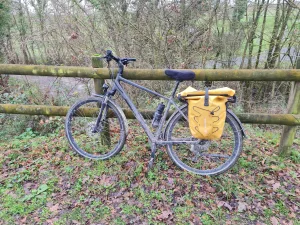
The most important piece of my kit is the bike. My Lonely Planet guide recommends a gravel or mountain bike with tyres at least 50 mm wide. The official Montañas Vacías website, however, states that tyres of at least 40 mm are required. This width is necessary because most of the route consists of gravel tracks, some of which are challenging. At the same time, tyres that are too wide don’t perform well on roads, which I’ll also be using in the Montañas Vacías.
My touring bike is fitted with 47 mm tyres. I decide not to change them as it has already been ridden on rocky dirt tracks in Spain and Greece.
Next, I need to make sure I have enough water and battery power on my mobile phone. In one of the least populated areas of Europe, these are vital resources. So I buy a power bank. As for water, I only have a 750 ml bottle. I get another one, a 950 ml one, and pack a small bottle in my luggage, bringing the total capacity to 2 litres.
I also buy two Figolu bars, balanced treats that accompany me on every touring bike trip.
The day before I set off, I need to make a list of everything I need to pack into my two panniers. Amongst these items are, of course, my sleeping bag, my tent and my camping stove. Another essential is my knee brace, which I used to wear a few years ago when I had tendonitis. This is the first time I take it with me on a cycling trip. I reckon it’s essential to stop my right knee from hurting too much.
On the other hand, I don’t plan out my daily route. First of all because I don’t have time for that, and also because it would stress me out. I’ll study the route during the long journey by train and bus to my starting point. My plan is to ride at my own pace each day and stop when I’m tired to pitch my tent.
On the morning of my departure, I take my bike out of the cellar, pump my tyres up to the maximum recommended pressure and gather my things.
As I ride to the Bordeaux station, I feel the joy of the start of the holidays — my first in 4 months — but also some anxiety. I haven’t prepared for this sporting challenge as well as I would have liked, and the route ahead is a mystery, but in the end, I’m setting off mainly to slow down and recharge my batteries in nature.
You can read the story of my adventure in the Montañas Vacías here.